By Rachid Razouk, Lahcen Hssaini, Yassine Bouslihim and Hakim Boulal
Failing to adjust fertilization may worsen the impact of water stress. A Moroccan olive study reveals that reasonable reductions in NPK supply under deficit irrigation can sustain high yield levels, fruit physical quality, and olive oil composition. The oil produced under these conditions was richer in health-promoting compounds thus boosting long-term value. The key for growers facing climate change is finding a sustainable balance that enhances tree resilience without severely compromising yield and oil quality.
The interaction between plant mineral nutrition and water availability is one of the most critical determinants of crop productivity under changing climatic conditions. Nutrient uptake, transport, and assimilation is altered under water deficit, and nutrient imbalances may, in turn, exacerbate the physiological effects of water stress. Managing these two factors in isolation is therefore insufficient. Their combined optimization is essential for maintaining plant productivity and stability.
Recent studies highlight that well-calibrated nutrient management under moderate water stress can enhance root efficiency, sustain photosynthetic activity, and improve crop quality (Bhattacharya., 2021). Striking this balance, between conserving water and ensuring adequate nutrient supply, represents a key strategy for building plant resilience. Controlled field trials that explore this equilibrium are vital to guide growers toward more sustainable and resource-efficient production systems capable of maintaining yield and quality under climate uncertainty.
Building on this scientific premise, the Olive-FertiClim project was launched as a collaborative initiative between the African Plant Nutrition Institute (APNI) and the National Institute for Agricultural Research (INRA-Morocco). By examining the interplay between water and nutrition, the study sought to define an optimal balance that boosts the tree’s resilience, enhances oil quality and value, and provides a sustainable and profitable path forward for Moroccan growers.
Olive was selected as the target crop for this research since it represents a strategic agricultural sector and the heart of Morocco’s agricultural landscape, a vital source of livelihood, culture, and rural stability. But today, growers face a complex squeeze from global changes. Climate change is intensifying water scarcity, making every drop of irrigation water more precious than ever (Tanasijevic et al., 2014). At the same time, there remains a knowledge gap on how to properly manage agricultural practices, particularly fertilization strategies under drought conditions, to sustain productivity and quality. Fertilizer efficiency is directly tied to water availability (Erel et al., 2008). Too little water, and the tree cannot absorb the nutrients growers have paid for. Too much irrigation, and those same expensive nutrients can leach away from the roots, wasting money and potentially harming the environment. These intertwined issues pose a direct threat to the resilience of olive growers (Gucci and Caruso, 2011). Addressing them requires practical, field-tested strategies to rationalize fertilizer use, improve water–nutrient interactions, and sustain the production of high-quality, sustainably produced olive oil. In this context, the present study was undertaken to explore practical pathways for optimizing NPK fertilization under different deficit irrigation regimes, thereby contributing to the development of more resilient and resource-efficient olive production systems.
Study description
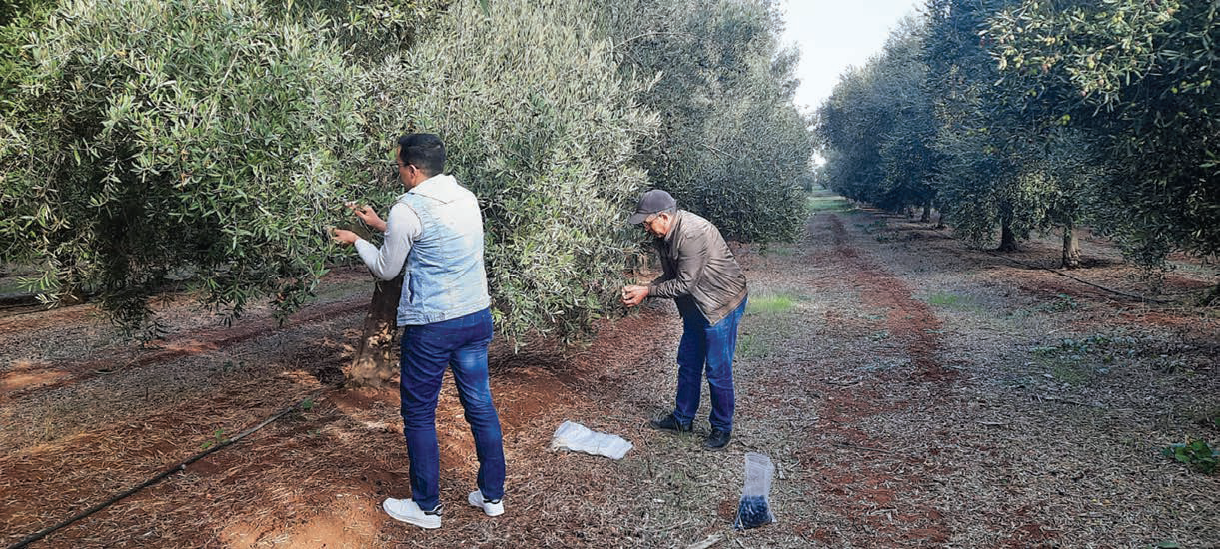
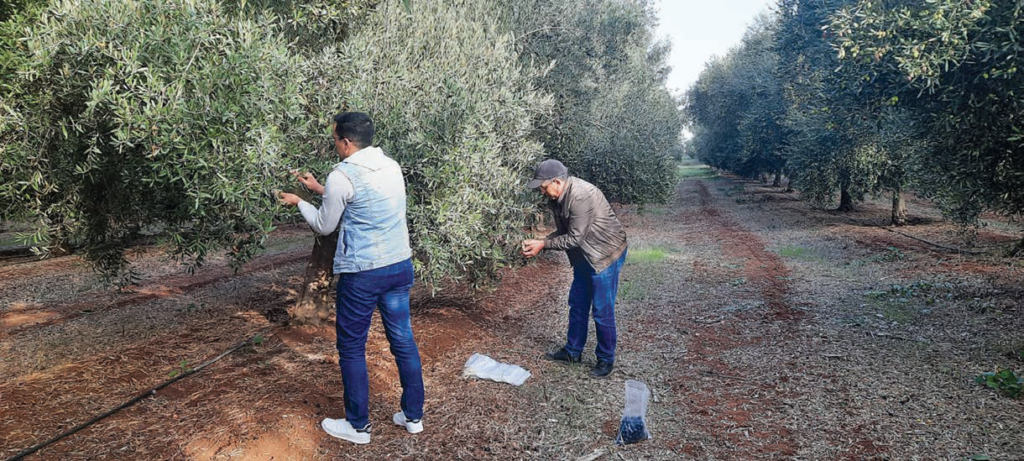
Conducted over two consecutive growing seasons in Morocco’s fertile Saiss region, the experiment was carried out in a 10-year-old private olive orchard planted with the country’s predominant olive cultivar, ‘Picholine Marocaine’. The orchard was established at a density of 285 trees ha-1 (7.5 m spacing) on a low-organic.matter soil (0.8%), with moderate levels of available phosphorus (P) (19.9 ppm) and potassium (K) (132 ppm). The study employed a crisscross factorial design arranged in three replicated blocks (Fig. 1), to evaluate the combined effects of three different resource management strategies.
Water Levels: Three irrigation regimes were applied: full irrigation supplying 100% of the crop evapotranspiration (ETc), moderate defcit irrigation at 75% ETc, and severe water stress a 50% ETc.
Fertilizer Levels: Each water level was combined with three distinct NPK fertilization plans. The recommended NPK rates were frst calculated for a fully irrigated orchard (100% ETc) targeting a yield of 10 t ha-1, based on soil analysis. Relative to this reference, the treatments consisted of a low dose (50% of the recommended needs), a medium dose (75%), and a high dose (100%).
Throughout the study, the efects of these nine treatment combinations, each replicated three times, were assessed on vegetative growth, yield components, physiological traits indicative of the tree’s water and nutritional status, alongside the biochemical characteristics of the olive oil.
Agronomic and physiological responses
The study frst quantifed the efects of varying irrigation and fertilization levels on key agronomic and physiological parameters. A multivariate analysis of variance (MANOVA) revealed that water level, NPK fertilization rate, and their interaction had statistically significant effects across the range of measured variables. Water availability emerged as the dominant factor influencing productivity, while fertilization showed limited effects, and some variables were significantly affected by their interaction (Table 1).
Table 1. MANOVA significance levels for irrigation, fertilization, and their interaction on agro-physiological traits and olive-oil biochemical attributes.
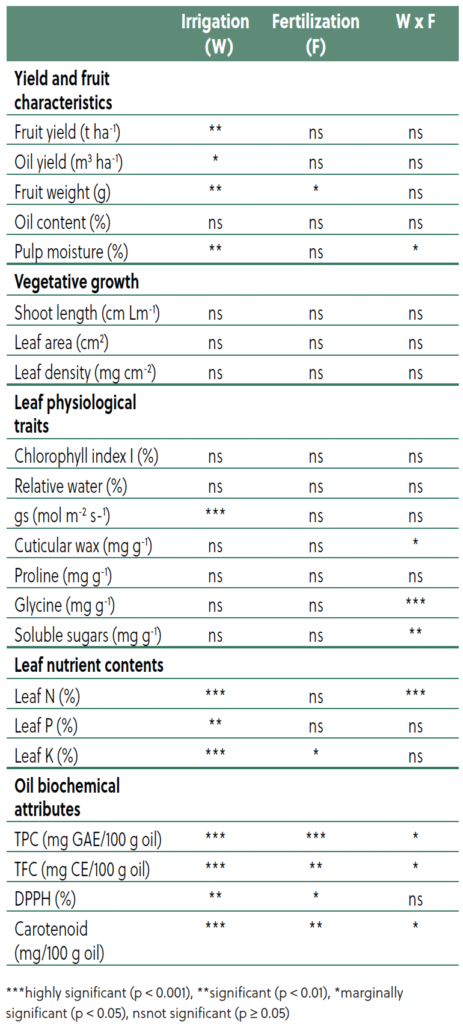
Water availability exerted a significant influence on the main yield components. Fruit yield (p = 0.002), oil yield (p = 0.017), and individual fruit weight (p = 0.008) all increased with higher irrigation levels, confirming that water is a key limiting factor for productivity in this olive system. The significant effect on oil yield was primarily driven by the increase in fruit yield, as fruit oil content showed no detectable response. However, NPK fertilization alone had a statistically significant effect only on fruit weight among the yield components (p = 0.028), suggesting that nutrient supply influenced the partitioning of assimilates at the fruit level rather than total yield. This finding implies that the effect of fertilization on olive productivity may manifest progressively over the long term, whereas the influence of irrigation on yield was already evident from the first two years of experiment.
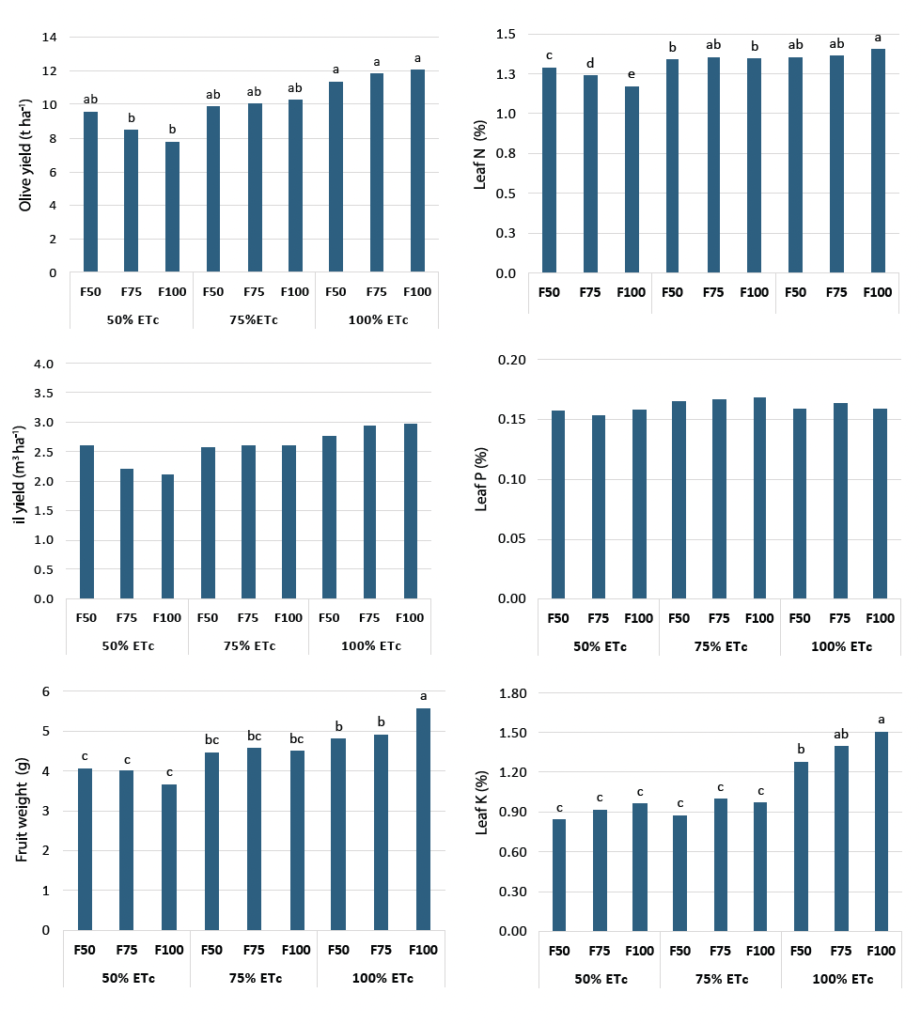
According to the ANOVA results, the patterns observed for fruit yield, oil yield, and fruit weight further confirm the dominant influence of irrigation and the modulating role of fertilization (Fig. 2). The highest fruit yields were obtained under full irrigation (100% ETc) and moderate water deficit (75% ETc), which performed similarly, with no significant effect of fertilization. Under severe deficit (50% ETc), increasing NPK fertilization to 75% or 100% led to a marked decline in yield, yet productivity could be restored to levels comparable with the 75% ETc regime by reducing fertilization to 50%. A similar trend was observed for fruit weight, except that lowering fertilization at 50% ETc did not improve fruit size, while under full irrigation, higher NPK inputs clearly enhanced it. No significant differences were observed for oil yield, likely because marginal increases in fruit oil content under water deficit compensated for lower fruit production. These findings suggest that the practice of applying full-rate nutrient inputs along with deficit irrigation may exacerbate yield losses.
Vegetative growth parameters, including shoot length, leaf area, and leaf density, were generally less responsive to both irrigation and fertilization. No significant effects were observed for these traits, suggesting that the vegetative growth of 10-year-old trees may be less sensitive to short-term variations in water and nutrient supply. These findings indicate that while water and nutrient management are crucial for fruit development and quality, they exert a comparatively limited immediate effect on canopy growth metrics within the timeframe of this two-season study.
In contrast, leaf physiological traits displayed diverse responses. Stomatal conductance (gs) was strongly influenced by irrigation (p < 0.001), reflecting the trees’ immediate response to water availability. Meanwhile, parameters such as cuticular wax content (p = 0.029), leaf glycine (p < 0.001), and soluble sugar content (p = 0.005) were significantly affected by the interaction between irrigation and fertilization, demonstrating that the physiological adaptation of leaves to water stress is modulated by nutrient supply.
Leaf nutrient concentrations were primarily influenced by irrigation levels and their interaction with fertilization. Leaf nitrogen (N) content was significantly affected by irrigation (p < 0.001) and the ‘irrigation . fertilization’ interaction (p < 0.001), while leaf P responded only to irrigation (p = 0.003) and K was significantly influenced by both irrigation (p < 0.001) and fertilization (p = 0.019). These results indicate that nutrient uptake and accumulation in leaves are closely tied to water availability, and that fertilization can further modulate nutrient status when considered in combination with irrigation, emphasizing the importance of integrated water–nutrient management for optimal tree performance.
The ANOVA results further clarify the combined influence of irrigation and fertilization on leaf nutrient concentrations (Fig. 2). Leaf N content showed a marked decline under severe water deficit (50% ETc), particularly at higher NPK levels, confirming that nutrient uptake efficiency decreases when water becomes limiting. This reduction likely reflects restricted root activity and possible salt accumulation in the rhizosphere under stress conditions (Brito et al., 2019). Similarly, leaf K was significantly reduced under both moderate (75% ETc) and severe (50% ETc) deficit irrigation. In contrast, leaf P remained statistically unaffected by either factor, suggesting a more stable internal regulation or sufficient baseline availability in the soil. These findings highlight that maintaining full-rate fertilization under water stress can hinder N absorption and disrupt ionic balance, which may, in turn, explain the limited responses observed in yield components.
Overall, the findings underscore the predominant role of water availability in shaping olive productivity. Under full irrigation, balanced NPK fertilization appears to enhance the tree’s nutritional status, improving fruit weight and potentially supporting long-term stability of both fruit and oil yields. In contrast, under water deficit, the weak fertilization response and absence of significant improvements in yield components indicate that applying full-rate NPK is neither efficient nor agronomically justified. Nutrient management should therefore be aligned with water availability, avoiding excessive input under stress conditions. A moderate fertilization regime, tailored to reduced irrigation, would likely improve nutrient use efficiency, maintain physiological balance, and optimize resource use without compromising sustainability.
Impact on olive oil’s biochemical profile and quality markers
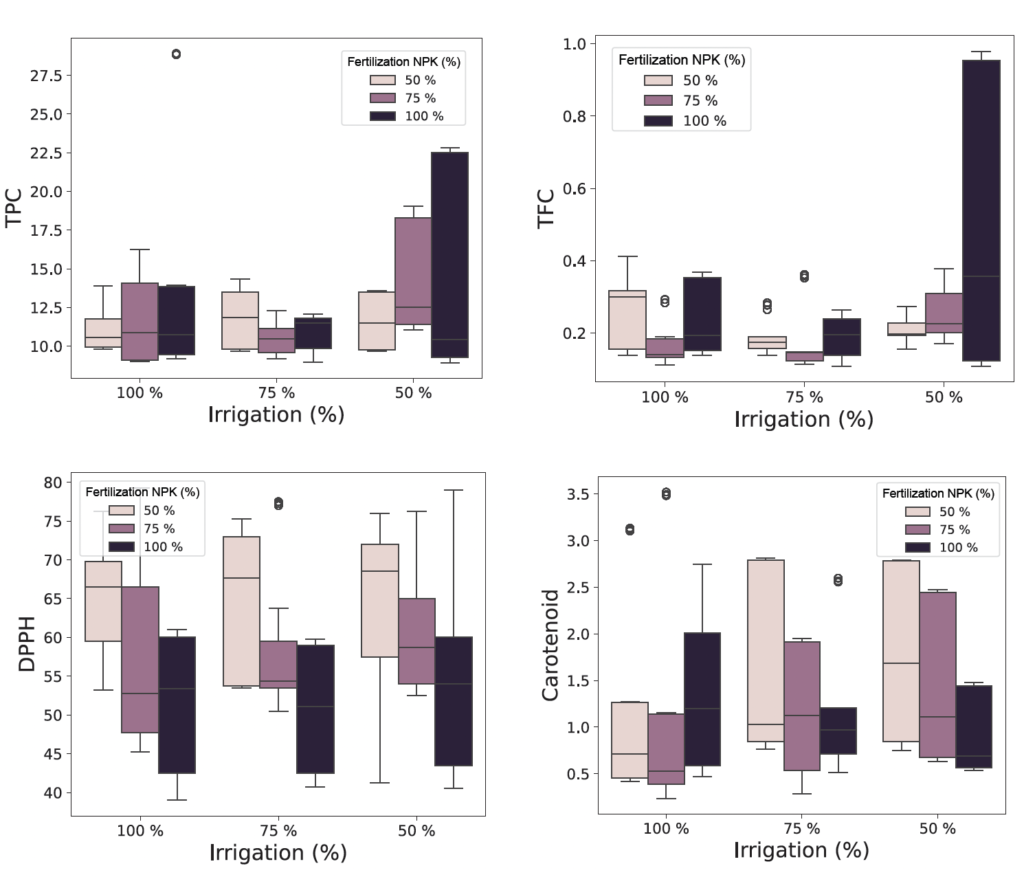
This study supports the view that the interplay between controlled water deficits and tailored nutrient applications is a key driver of olive oil quality (Servili et al., 2004). MANOVA results confirmed that irrigation (W), fertilization (F), and their interaction (W.F) significantly influenced the oil’s biochemical profile (Table 1). This was particularly evident in the upregulation of high-value secondary metabolites; for both Total Phenolic Content (TPC) and Total Flavonoid Content (TFC), the combination of severe water stress (50% ETc) and balanced-to-high fertilization (75-100% NPK) produced the highest concentrations (Fig. 3), with statistically significant interaction effects (W.F: p≤0.040) driving increases of up to 30%. However, the study also revealed a more complex metabolic response, where the interplay for other quality markers was different. Maximum antioxidant activity (DPPH) and carotenoid content were achieved with a contrary combination: severe water stress (50% ETc) paired with minimal fertilization (50% NPK).
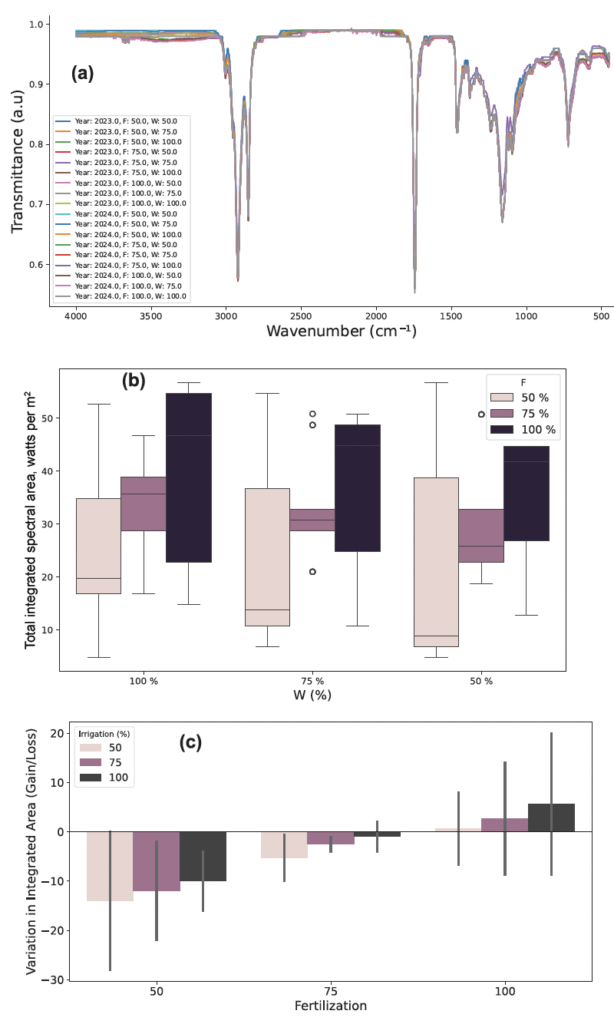
These divergent biochemical shifts were corroborated at a molecular level using Mid-Fourier Transform Infrared (FTIR) spectroscopy. This analysis provided a chemical fingerprint of the oil based on the raw spectra (Fig. 4a). These complex spectra were then quantified by measuring the total integrated spectral area—a measure of the abundance of key chemical bonds associated with oil quality. As shown in Fig. 4b, this analysis revealed a clear interaction where increasing fertilization, combined with adequate water, maximized this molecular quality marker. The main effects plot (Fig. 4c) further clarified that while lower irrigation tended to decrease the area, higher fertilization strongly increased it, reinforcing the importance of their combined management. This molecular evidence validates the observed quality improvements, confirming that the specific interplay between water and nutrient levels—not just stress alone—is a key mechanism for producing a biochemically superior final product.
Summary
This research clarifies a critical dichotomy between agronomic strategies that optimize the biochemical quality of olive oil. While severe water stress (50% ETc) is the most potent driver for accumulating high-value bioactive compounds like phenols, it poses quantifable risks to long-term orchard viability and yield stability. The data clearly shows that growers must navigate a trade-of between maximizing oil quality and maintaining tree health. Therefore, the study identifes moderate defcit irrigation (75% ETc) combined with balanced fertilization (75% NPK) as the optimal, sustainable compromise for the ‘Picholine Marocaine’ cultivar under these conditions. Under more severe water limitation (50% ETc), imposed by restricted water availability, the study further suggests reducing NPK fertilization to 50% to sustain the best possible yield performance and overall tree function under such stressful conditions. These scientifcally validated regimes efectively mitigate the severe yield penalties and vegetative decline associated with more extreme stress, while simultaneously securing a signifcant enhancement in phenolic content, a key driver of market value and consumer preference. This data-driven approach ofers a practical and resilient strategy for olive growers, enabling them to enhance product value and build climate resilience by aligning sustainable resource management with economic proftability. However, it is important to emphasize that the experimental values reported here are not direct recommendations for farmers but rather indicative trends suggesting the need to reduce fertilization under water deficit, a level that remains to be confrmed over the long term.
Acknowledgement
This research was made possible with funding from APNI under the African Plant Nutrition Research Fund (APNRF). We thank Lesieur Cristal Company and INRA technicians Abdellatif Benbouazza, Chemsdoha Khalfi, and Nabil Ahrir for their support.
Dr. Razouk (rachid.razouk@inra.ma), Dr. Hssaini, and Dr. Bouslihim are with the National Institute of Agricultural Research, Rabat, Morocco. Dr. Boulal is Senior Scientist, APNI, Settat, Morocco.
Cite this article
Razouk, R. Hssaini, L. Bouslihim, Y. Boulal, H. 2025. When Less is More: Optimizing Fertilizer Use under Water Deficit to Enhance Olive Tree Productivity and Resilience. Growing Africa 4(2):55-60. https://doi.org/10.55693/ga42.USCI3043
REFERENCES
Bhatacharya, A. 2021. Soil water defcit and physiological issues in plants. Springer Nature Singapore.
Brito, C., et al. 2019. Drought stress efects and olive tree acclimation under a changing climate. Plants, 8(7), 232.
Erel, R., et al. 2008. The importance of olive (Olea europaea L.) tree nutritional status on its productivity. Scientia Hort., 159, 8-18.
Gucci, R., Caruso, G. 2011. Environmental stress and sustainable olive growing. Acta Hort., 924, 19-30.
Servili, M., et al. 2004. Health and sensory properties of virgin olive oil hydrophilic phenols: agronomic and technological aspects of production that afect their occurrence in the oil. J. Chromatography A, 1054(1-2), 113-127.
Tanasijevic, L., et al. 2014. Impacts of climate change on olive crop evapotranspiration and irrigation requirements in the Mediterranean region. Agric. Water Manage., 144, 54-68.