
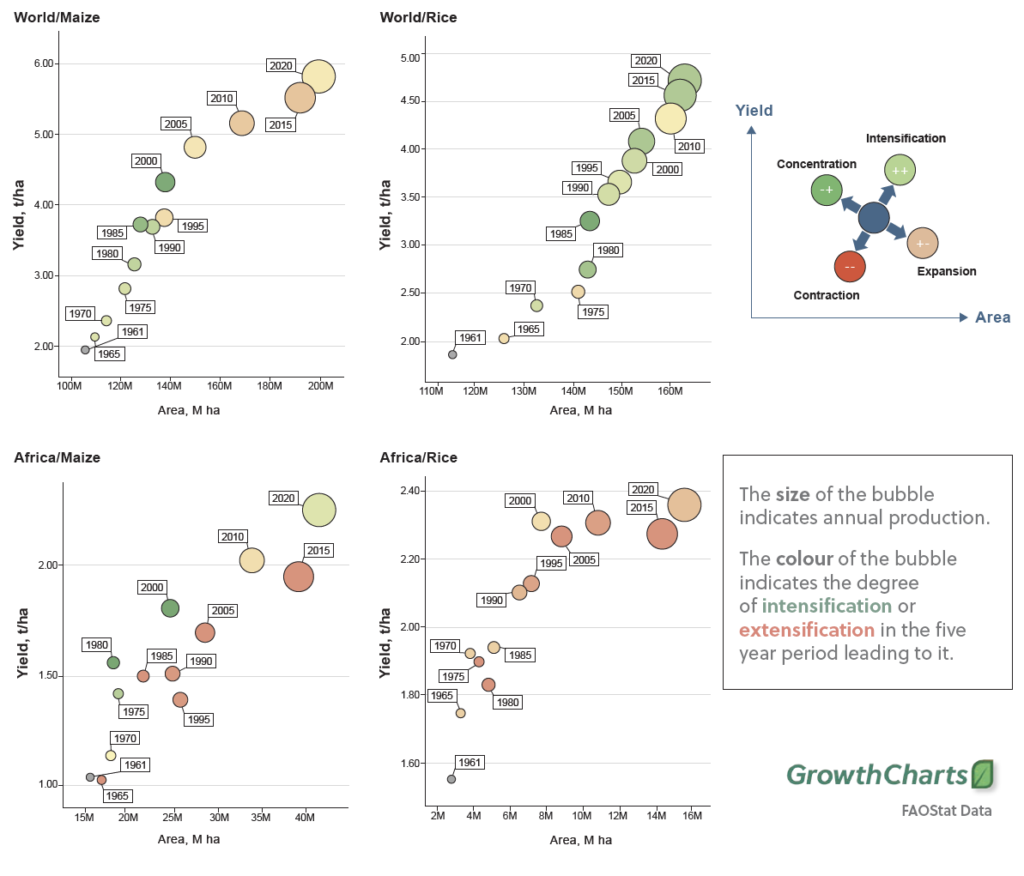
The diagram shows that intensification (green quadrants) dominates World Rice and early World Maize, while extensification (red quadrants) is prominent in Africa Rice and recent World Maize. Contraction (bottom-left) and land sparing (top-left) are not strongly evident.
Four pathways of agricultural change.
Agricultural systems grow and evolve in different ways depending on pressures such as population demand, input availability, land resources, and climate conditions. Four key strategies describe these shifts:
1. Intensification – Increasing crop yield per hectare using more or better inputs (e.g., fertilizer, improved seeds, mechanization);
2. Extensification – Expanding the total cultivated area, often into marginal lands or new regions;
3. Concentration – Focusing agricultural production in fewer regions or larger farms to achieve economies of scale, and
4. Contraction – Reducing cultivated area due to land degradation, urbanization, or shifts to other land uses like conservation.
These strategies don’t occur in isolation; they often overlap and shift over time. The bubble charts for maize and rice production across the World and Africa (1961–2020) reflect how these strategies play out. Each chart plots average yield (t/ha) against average area (million ha), with bubble size showing production and color indicating recent development patterns (green = intensification, red/orange = extensification). A quadrant diagram helps place each trend in the broader conceptual framework.
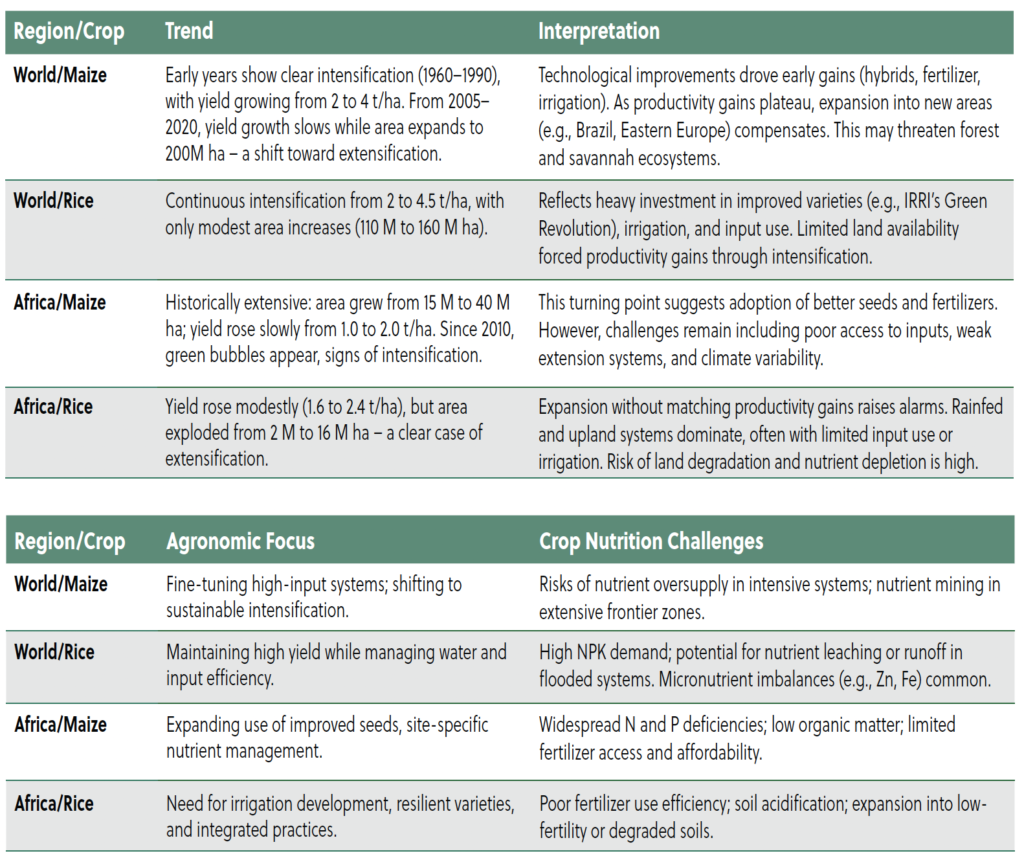
Observed Trends in Maize and Rice Production
The above Tables summarize key patterns observed in the maize and rice production data from 1961–2020, including the agronomic implications.
Agronomic and Crop Nutrition Implications: Understanding the agronomic meaning behind these patterns is essential for guiding future action. Where yield gains stall and land expands, agronomic efficiency suffers. Where intensification dominates, soil health and input use must be managed carefully to avoid long-term decline.
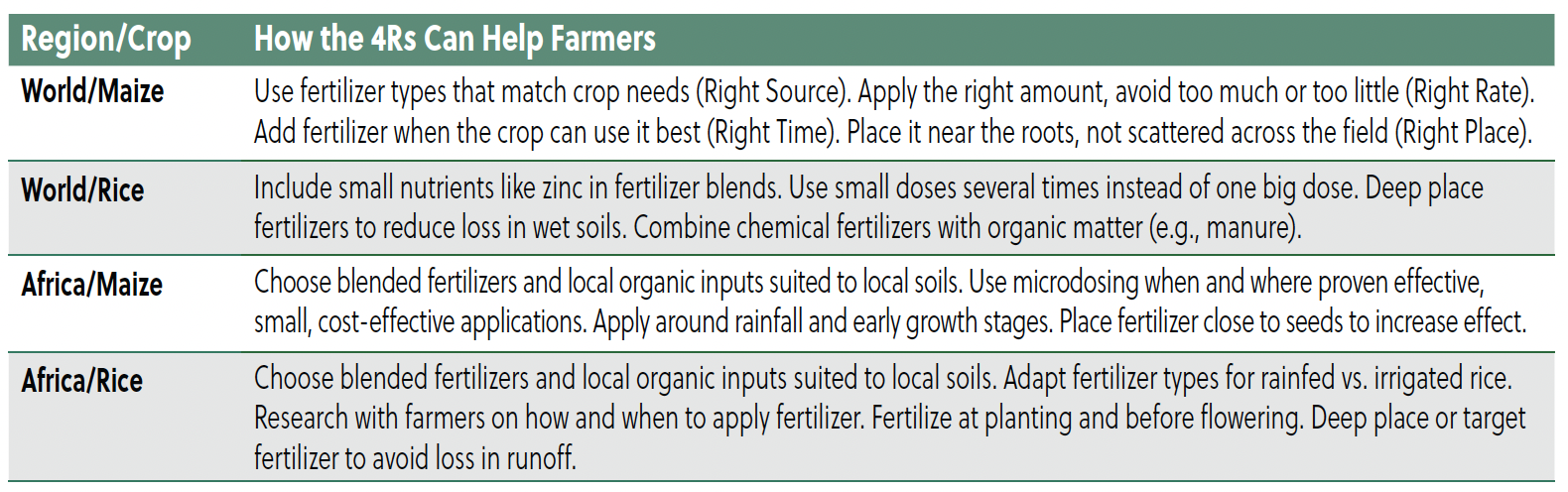
The Role of 4R Nutrient Stewardship: The 4R Nutrient Stewardship Framework, Right Source, Right Rate, Right Time, and Right Place, offers a proven, flexible approach to managing fertilizer use efficiently and sustainably. The Table below outlines how the 4Rs can help improve productivity and sustainability for maize and rice in both global and African contexts:
Comparative Highlights
Rice (Global vs. Africa)
Global rice systems have matured through decades of research, irrigation and intensive management, delivering reliable productivity from the same land base. The chart displays consistent yield growth (from
2.0 to 4.5 t/ha) and moderate area expansion (from 110 M to 160 M ha) over 1961–2020, with mostly green bubbles indicating sustained intensification. 1961–2020 (Intensification): Rice production has primarily increased through yield improvements (e.g., from 2.0 t/ha in 1961 to 4.5 t/ha in 2020), with a smaller increase in area (110M to 160M ha). The persistent green bubbles suggest a focus on boosting productivity per hectare, likely due to land and water constraints in rice-growing regions (e.g., Asia). While the area grew modestly, the dominant strategy has been intensification, reflecting efforts to meet rising food demand without vastly expanding farmland. This focus on intensification highlights the need to maximize output in regions with limited land availability. However, it may strain resources like water and soil, necessitating sustainable practices to maintain long-term productivity.
African rice systems are still reliant on land expansion. Productivity remains low due to minimal irrigation, input use, and support infrastructure. Africa must move beyond area expansion toward sustainable intensification. Better seed-fertilizer combinations, and 4R-based training can accelerate this transition. The chart shows moderate yield growth (from 1.6 to 2.4 t/ha) and significant area expansion (from 2M to 16M ha) over 1961–2020, with red bubbles in recent years indicating persistent extensification. 1961–2020 (Extensification): Rice production has relied heavily on expanding cultivated area (2M to 16M ha), with yields increasing only modestly (1.6 to 2.4 t/ha). Red bubbles suggest that output growth has come from bringing more land into cultivation rather than boosting productivity, possibly due to barriers like limited irrigation or technology adoption. Persistent Extensification (2010–2020): Unlike maize, rice continues to prioritize area expansion over yield gains, reflecting challenges in intensifying production for this water-intensive crop. This reliance on extensification raises sustainability concerns, such as land degradation or deforestation. Promoting sustainable intensification, e.g., through improved water management or high-yielding varieties, could help balance production and environmental goals.
Maize (Global vs Africa)
Global maize began with heavy intensification, but recent shifts to extensification show signs of ecological strain. The chart shows a steady increase in both yield (from 2.0 to 6.0 t/ha) and area (from 100 M to 200 M ha) between 1961 and 2020. Early years (1961–1990) feature green bubbles, indicating intensification, while later years (2005–2020) show orange bubbles, signaling a shift to extensification. 1961–1990 (Intensification): During this period, maize production grew primarily through higher yields (e.g., from 2.0 t/ha in 1961 to 4.0 t/ha in 1990), with moderate area expansion (100 M to 140 M ha). This suggests technological advancements, such as improved seeds, fertilizers, and irrigation, drove productivity gains, aligning with intensification. 2005–2020 (Extensification): In recent decades, yield growth slowed (reaching 6.0 t/ha by 2020), while the area expanded significantly (to 200M ha). The shift to orange bubbles indicates that production increases relied more on cultivating additional land rather than further boosting yields, reflecting extensification. This may stem from yield improvements hitting a plateau or new land becoming available. Implications: The transition from intensification to extensification suggests that early productivity gains were technology-driven, but recent growth has leaned on land expansion, potentially raising environmental concerns like deforestation or habitat loss.
Africa’s maize sector is showing early success in intensifying, a promising trend, if supported by access to appropriate technologies and inputs. Africa is at a crucial inflection point. 4R strategies can help smallholders improve yields and protect soil resources, especially under increasing climate stress. The chart shows slow yield growth (from 1.0 to 2.0 t/ha) and significant area expansion (from 15 M to 40 M ha) over 1961–2020. Early years (1961–1990) feature yellow to red bubbles (extensification), while recent years (2010–2020) show yellow to green bubbles, indicating a shift toward intensification. 1961–1990 (Extensification): Initially, maize production grew through area expansion (15 M to 30 M ha), with yields stagnating at 1.0–1.5 t/ha. Red bubbles suggest that output increased by cultivating more land rather than improving productivity, possibly due to limited access to technology or infrastructure. 2010–2020 (Shift to Intensification): In recent years, yields rose to 2.0 t/ha, while area growth slowed (35 M to 40 M ha). The shift to green bubbles indicates a focus on improving productivity, likely through better farming practices, seeds, or fertilizers, reflecting efforts to enhance food security. The move toward intensification is a positive step for sustainable agriculture in Africa, reducing reliance on land expansion. However, challenges like input access and climate variability may limit further progress.
Toward Smarter, More Sustainable Growth
Maize and rice exhibit distinct trajectories. World Maize shifted from intensification to extensification, reflecting a move from technology-driven gains to land-based growth. World Rice has maintained intensification, likely due to land constraints in key regions. These differences highlight how crop biology, growing conditions, and socio-economic factors shape agricultural strategies. The graphs illustrate more than just maize and rice data, they highlight development pathways, agronomic trade-offs, and future priorities. They underscore that: Intensification must now focus on sustainability, especially for systems nearing ecological limits. Extensification, still common in Africa, can no longer be the primary growth model. It risks soil degradation, biodiversity loss, and declining marginal returns. 4R Nutrient Stewardship presents a powerful, adaptable solution: helping farmers grow more with less, use fertilizers wisely, and protect their land. Across contexts, smart nutrition strategies grounded in local conditions can make agriculture more productive, profitable, and sustainable. In the face of growing food demand, changing climate, and limited land, the 4Rs offer a clear roadmap to feed the future, without exhausting it. In Africa, both maize and rice historically leaned on extensification, but maize is now shifting toward intensification, possibly due to its status as a staple crop and targeted investments.
Contributors: Dr. Simon Cook, Adjunct Professor, Murdoch University, Perth, Australia. Dr. Thomas Oberthür, Director of Business & Partnerships. Mr. Gavin Sulewski, Senior Editor.

GrowthCharts briefly explores perspectives on key issues, concepts and needs related to the development of African agriculture. For more visit: www.apni.net/GrowthCharts