By Intissare Mouamine, Ngonidzashe Chirinda, Amine El Khouni, Mahdi Dahane, Aziz Soulaimani, Hakim Boulal
Olive tree nitrogen (N) response in northern Morocco varied strongly with soil pH. In alkaline soils, moderate N fertilization improved leaf N status, while higher rates showed no added benefit, whereas acidic soils showed little response due to sufficient baseline N availability. Results underscore the importance of tailoring N management to soil chemistry to improve nutrient efficiency and climate resilience in Mediterranean olive systems.
Olive trees (Olea europaea L.) are widely cultivated under Mediterranean climates and are valued not only for their fruit but also for high-quality olive oil production. As a perennial evergreen species, olive trees require balanced nutrition to sustain growth, fruit development, and resistance to environmental stresses.
Nitrogen (N) is one of the most critical macronutrients for olive trees. It plays a pivotal role in the synthesis of amino acids, proteins, nucleic acids, and chlorophyll, all of which are essential for photosynthesis and various metabolic activities (Erel et al., 2023). Unlike other nutrients, N has a strong influence on the vegetative vigor of olive trees and the timing and quality of fruit production. However, N deficiency is a common problem in olive orchards, especially under dryland farming systems or in soils with unfavorable properties such as low organic matter and poor moisture retention (Fern.ndez-Escobar et al., 2009). N deficiency symptoms manifest primarily as chlorosis of leaves, reduced leaf size, delayed flowering, and diminished fruit yield (Roca et al., 2018). The uptake and assimilation of N in olive trees are highly influenced by water availability. Water scarcity or drought conditions can impair N uptake by reducing root growth, limiting nutrient diffusion in the soil, and decreasing nitrate reductase activity in leaves (Naija et al., 2014). As a result, N use efficiency declines under water stress conditions (Baccari et al., 2020).
Soil properties, including pH and texture, directly affect N availability and its form (nitrate or ammonium). These factors influence N mineralization and immobilization processes conducted by soil microorganisms (Zhou et al, 2019). In olive trees, low pH improved leaf macronutrient content and, thus, vegetative growth parameters, through the direct effect of pH on nutrient solubility (Beheiry et al., 2023).
Given the importance of N for olive production and the difficulty of its direct assessment, nondestructive methods based on chlorophyll quantification have gained prominence. Since chlorophyll molecules contain N, chlorophyll content in leaves is a reliable proxy for N status. Portable chlorophyll meters provide quick, real-time estimates of leaf N concentrations, enabling precision nutrient management without harming the plant (Boussadia et al., 2011).
Study details
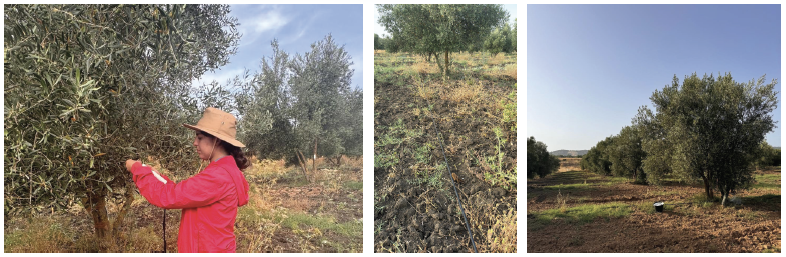
The study was conducted in the Ouezzane region of northern Morocco, which is characterized by a sub-humid Mediterranean climate. The area receives an average annual precipitation of 650 mm and has a mean temperature ranging from 11ÅãC to 26ÅãC. Two independent experiments were conducted during the 2024/2025 olive growing season at two sites within the same rural community, located 4.5 km apart. The first site A (34.819192, –5.463778) had a clay soil texture with 2.45% organic matter (OM), 0.16 mg/kg total nitrogen (TN), 15 mg/kg available P2O5, 443 mg/kg exchangeable K2O, and a soil pH of 8.5. The second site B (34.831284, –5.633601) was classified as clay loam, with 1.17% OM, 0.08% kg TN, 35.1 mg/kg P2O5, 133.7 mg/kg K2O, and a soil pH of 6.2 (Table 1). The experiments were conducted on irrigated plots with surface water from a dam with a pH above 8 and a nitrate content <0.9 mg/l on 13-year-old ‘Moroccan Picual’ olive trees with a planting density of 100 trees per hectare. A randomized complete block design (RCBD) with three blocks was implemented.
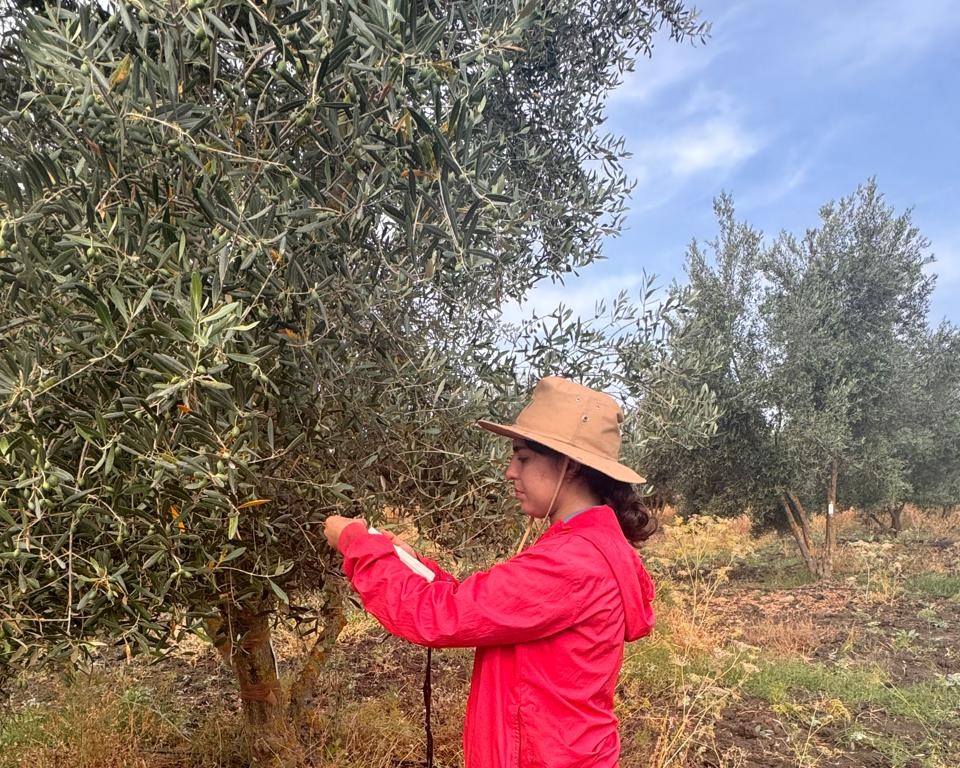
Nitrogen (N) application was the main treatment factor, with rates based on a potential yield of 60 kg fruit per tree: 0% (control 0, T0), +50% (0.125 kg N/tree, T1), +100% (0.250 kg N/tree, T2), and +150% (0.375 kg N/tree, T3). The percentages of N input are expressed relative to the recommended N requirement (e.g., 50% corresponds to half of the recommended N requirement). Each experimental plot consisted of four central trees, surrounded by guard rows of six trees on either side and one tree at both the northern and southern borders. Ammonium nitrate (33.5%) was used as the N source, applied in two equal splits in April and June. Soil samples were collected in January (dormancy stage) from 14 trees per site, targeting the active root zone under the canopy. Samples were taken at two depths (0-20 cm and 20-40 cm), with four replicates per depth. Leaf samples were collected during dormancy in January before fertilization. From 24 trees per site, 100 leaves per tree were randomly collected to establish a baseline nutrient status. During the pit-hardening stage, chlorophyll content was measured non-destructively using a portable SPAD-502Plus chlorophyll meter on 20 young leaves per tree per treatment per block. Leaf N content was further estimated from SPAD values using the regression model developed by Boussadia et al. (2011), under the assumption that N represents approximately 3% of total chlorophyll content.
Results
In the alkaline soil (Site A), SPAD chlorophyll index values (Chl) differed significantly among N treatments (p < 0.001). T2 (+100% N) produced the highest Chl values, significantly exceeding T0 (control) and T3 (+150% N), while T1 (+50% N) was statistically similar to T2 but higher than T3. In contrast, no significant treatment effects were detected in the acidic soil (Site B), where all treatments exhibited statistically equivalent Chl values (Fig. 1).
Estimated leaf N derived from Chl measurements followed the same pattern. In the alkaline soil, T2 showed the highest N content, with T1 intermediate and T0 and T3 presenting lower values. However, in the acidic soil, estimated leaf N varied only slightly among treatments, and the mean comparison test detected no significant differences (Fig. 2).
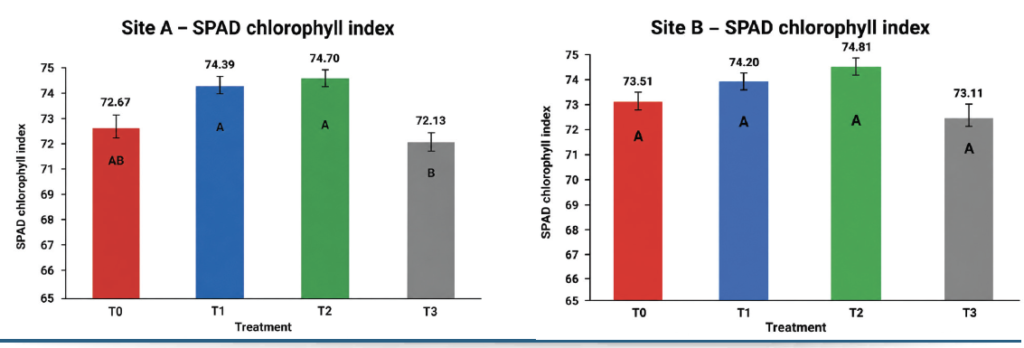
T1 = +50% N, T2 = +100% N, T3 = +150% N) in alkaline (Site A) and acidic (Site B) soils. Bars represent treatment means Å} SEM. Different letters indicate significant differences among treatments within each soil type according to Tukey’s HSD test at p < 0.05.
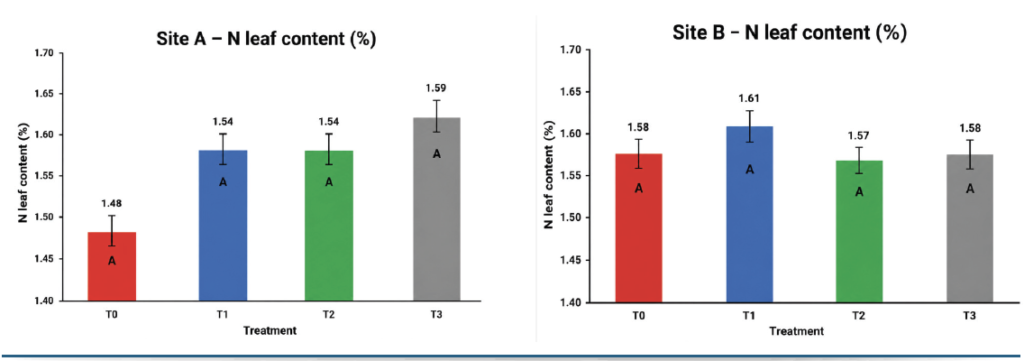
T1 = +50% N, T2 = +100% N, T3 = +150% N) in alkaline (Site A) and acidic (Site B) soils. Bars represent means Å} SEM. Different letters indicate significant differences among treatments within each soil type according to Tukey’s HSD test (p < 0.05).
Implications
The study provides valuable insights into the interactions between soil characteristics, N fertilization, and nutrient uptake dynamics in olive trees. The contrasting soil properties at the two sites—alkaline clay soil (pH 8.53) and acidic clay loam (pH 6.29)—highlight the significant influence of soil chemistry on nutrient availability and plant response to fertilization. Soil pH is one of the primary factors regulating nutrient transformations, retention, and availability by influencing microbial activity, mineral solubility, and cation exchange processes. Previous studies have shown that changes in soil pH substantially modify the balance between inorganic N forms. As soil pH declines, nitrate concentrations decrease while ammonium accumulates, reflecting shifts in nitrification dynamics (Kuśmierz et al., 2023). Moreover, soil reaction has been positively associated with clay, exchangeable Ca, and CaCO3 contents, and negatively correlated with sand content and the availability of micronutrients such as Fe, Mn, and Zn (Doğan and Gülser, 2020).
Alkaline soil exhibited a higher TN content in the soil but lower leaf N concentration (1.35%) below the adequate range (1.5–2.0%) defined by Fernandez-Escobar (2019). This result suggests that despite the soil N reserves, the bioavailability of N to the olive trees was constrained by high pH conditions, likely due to reduced N mineralization and increased ammonia volatilization under alkaline circumstances (Fern.ndez-Escobar et al., 2019). Conversely, the acidic clay loam soil, with lower TN but more favorable pH, facilitated adequate N uptake, evident in leaf N concentrations within the sufficiency range (1.64%). The beneficial effect of the moderately acidic soil observed in our study is consistent with previous reports showing that strongly acidic, Ca-deficient soils can impair olive growth, resulting in shorter trees with narrower trunks (Dent, 2020). However, the pH of the acidic clay loam site (6.29) remained within a range that appears favorable for N uptake without reaching the levels of severe acidity associated with growth limitations.
The Chl measurements using a portable SPAD meter, calibrated by the regression model from Boussadia et al. (2011), offered a non-destructive proxy for assessing leaf N status and physiological condition. The SPAD-derived leaf N estimates aligned with direct foliar analysis, displaying significant treatment effects only in the alkaline soil. In this soil, the highest N application rate (+150% N) led to a slight decline in leaf N content and chlorophyll accumulation compared to the +100% N treatment, implying a threshold beyond which N addition no longer benefits, or may even inhibit, nutrient assimilation and photosynthetic pigment synthesis (Ferreira et al., 2020). Such saturation could be attributed to imbalances in nutrient uptake or physiological stress caused by over-fertilization, consistent with findings from studies in Mediterranean cropping systems (Boussadia et al., 2011; Dag et al., 2016). These variations further illustrate the complexity of soil-plant nutrient interactions governed by soil physicochemical properties.
Conclusion
This work shows that what truly matters for olive tree nutrition is not only how much N is present in the soil, but whether the soil environment allows trees to use it. The contrast between the alkaline and acidic sites highlights this clearly: the same nutrient behaves very differently depending on soil pH. By using SPAD-derived estimates, this variability was captured at low cost and in real time, but the method still needs to be checked against the ongoing chemical analysis of leaf samples. This verification step is crucial to understanding how far the chlorophyll indices can be used as a proxy for N status. Beyond this, a bigger knowledge gap emerges as current regression models that link SPAD chlorophyll index values and leaf N are not adapted to the diversity of olive cultivars and growing conditions across the Mediterranean.
If the objective is that farmers make fertilizer decisions based on quick, affordable tools, calibrated models are needed for their varieties and soils. Future work should therefore aim at building such cultivar specific relationships. Doing so would bring truly accessible precision fertilization, helping farmers reduce costs and environmental impacts while maintaining productivity in a climate where every unit of water and N matters.
Ms. Mounamine (e-mail: i.mouamine@apni.net) is a Ph.D. candidate at the Agricultural Innovation and Technology Transfer Center (AITTC), Mohammed VI Polytechnic University (UM6P), Benguérir, Morocco. Dr. Chirinda is Associate Professor at AITTC, UM6P, Benguérir. Dr. El Khouni is Associate Scientist, APNI, Benguérir. Mr. Dahane is Agronomist, APNI, Benguérir. Dr. Soulaimani is Head of the Water, Soil and Plant Analysis Laboratory, AITTC, UM6P, Benguérir. Dr. Boulal is APNI Regional Coordinator of North Africa, APNI, Benguérir.
Acknowledgement
The authors acknowledge the financial support provided by the African Plant Nutrition Institute (APNI) for conducting this research.
Cite this article
Mouamine, I., Chirinda, N., El Khouni, A., Dahane, M., Soulaimani, A., Boulal, H. 2026. Effect of Soil pH on Nitrogen Response of Olive Orchards in Northern Morocco. Growing Africa 5(1):42-45. https://doi.org/10.55693/GA51.WJBI7302
REFERENCES
Baccari, S., et al. 2020. Linking leaf water potential, photosynthesis and chlorophyll loss with mechanisms of photo and antioxidant protection in juvenile olive trees subjected to severe drought. Front. Plant Sci. 11:614144.
Beheiry, H.R., et al. 2023. Response of multi-stressed Olea europaea trees to the adjustment of soil pH by acidifying agents: impacts on nutrient uptake and productivity. Agron. 13(2):539.
Boussadia, O., et al. 2011. Nondestructive determination of nitrogen and chlorophyll content in olive tree leaves and the relation with photosynthesis and fluoresence parameters. Photosynthetica 49(1):149-153.
Dent, S. 2020. Agricultural Liming is a Solution for Olive Tree Growth Deficits in Southern Italy. https://geoweb.princeton.edu/people/simons/PDF/frs/FRS-CCCI-2019-AgriculturalLiming.pdf
Doğan, B., et al. 2020. Soil quality assessment for olive groves areas of Menderes District, Izmir-Turkey. Eurasian J. Soil Sci. 9(4):298-305.
Erel, R., et al. 2023. Elevated fruit nitrogen impairs oil biosynthesis in olive (Olea europaea L.). Front Plant Sci. 14:1180391.
Fernández-Escobar, R., et al. 2009. Long-term effects of N fertilization on cropping and growth of olive trees and on N accumulation in soil profile. Eur. J. Agron. 31(4):223-232.
Fernández-Escobar, R. 2019. Olive nutritional status and tolerance to biotic and abiotic stresses. Front. Plant Sci. 10:1151.
Ferreira, I., et al. 2020. The effect of nitrogen applications on the growth of young olive trees and nitrogen use efficiency. Turkish J. Agric. and Forest. 44(3):278-289.
Naija, D.S., et al. 2014. Response of olive tree cultivars to different levels of nutrient stress. Eur. Sci. J. 10(33): 338-358.
Roca, L.F., et al. 2018. Nitrogen status affects growth, chlorophyll content and infection by Fusicladium oleagineum in olive. Crop Protection 109:80-85.
Zhou, W., et al. 2019. Effects of soil pH and texture on soil carbon and nitrogen in soil profiles under different land uses in Mun River Basin, Northeast Thailand. Peer J. 7:e7880.