By Brayan Valencia, Ivan Adolwa, Martha Okumu, Joses Muthamia, Simon Cook, and Thomas Oberthür
The 4R Nutrient Stewardship framework can collide with the operational realities of African smallholders. A diagnostic survey of 50 maize farmers across four Kenyan counties reveals a significant planting lag, reaching 10 days in Siaya, driven primarily by a critical liquidity window. While 91% of farmers cite a lack of immediate cash as the primary barrier to timely fertilization, topographical variability is also overlooked, with uniform application rates persisting despite recognized nutrient loss on slopes. To bridge this implementation gap, 4R recommendations must transition from static dates to adaptive “moving windows” that synchronize nutrient application with both environmental signals and the financial mobilization cycles of the household.
Moving beyond top-down agronomy
Recent research emphasizes that top-down approaches to delivering precision nutrient management have historically generated limited economic impact for smallholders (Adolwa et al., 2026). The 4R Nutrient Stewardship framework is recognized for its ability to identify optimized packages of practice for fertilizer use—ensuring the Right Source is applied at the Right Rate, Right Time, and in the Right Place—through balanced considerations of economic, social, and environmental goals. However, it can be further adapted, and reimagined, as an entry point for precision agriculture that respects the complexity of the smallholder landscape (Njoroge, 2022).
This preliminary study establishes a baseline diagnostic for reimagining 4R delivery. Optimizing nutrient timing requires aligning field-level practices with the macro-climatic drivers that dictate African seasonal patterns. Central to this is the role of teleconnections, such as the El Ni.o-Southern Oscillation (ENSO) and the Indian Ocean Dipole (IOD), which drive significant inter-annual variability in local climate events across Kenya.
The short rains are considerably less predictable than the long rains, largely because they are more strongly modulated by remote ocean conditions (Palmer et al., 2023). The Indian Ocean Dipole (IOD) is the main driver: when waters near the African coast run warmer than usual (positive phase), rainfall can triple; when they run cooler (negative phase), the rains can almost disappear. These extremes intensify during El Nino years, and the resulting “super-seasons” flood farmlands and wash away soils, crops, roads, and bridges.
The challenge: the friction of financial liquidity and topography
The implementation of 4R principles is frequently hindered by a “knowledge-action gap.” Preliminary data suggests that “right time” is not merely a seasonal or meteorological target but also a socio-economic one. Financial liquidity can create a timing bottleneck. For example, if a farmer cannot access funds within the precise window of the first rains, the agronomic benefit of the fertilizer is diminished.
Furthermore, field-level spatial variability, specifically topography is rarely managed. Uniform nutrient application across varying slopes leads to systemic inefficiency (Vanlauwe et al., 2010; Zingore et al., 2007). The motivation behind this uniform application is rooted in long-standing cultural trends; with an average farmer age of 51 years, these traditional practices have been passed down for decades. Farmers often accept the trade-off of simplified labor over the complexities of variable-rate application. This leads to scenarios where nutrients are lost to runoff on upper slopes while being overconcentrated in deposition zones (Njoroge, 2022). In these zones, poor crop response is exacerbated by low soil fertility. Consequently, farmers apply high, equal rates of fertilizer across the entire farm to compensate for this inherent infertility, even though the local weather patterns make these slopes highly prone to both erosion and severe drought.
Methodology: a diagnostic baseline in four counties
An interview-based diagnostic assessment was conducted from January 27 to February 11, 2026, involving 50 maize farmers in Siaya, Kakamega, Embu, and Machakos. To ensure high-quality data and farmer trust, this assessment leveraged existing APNI-supported on-farm experimentation (OFE) networks. While OFE initiatives focus on actively engaging farmers to co-develop site-specific technologies (Adolwa et al., 2026), this specific study functioned as a diagnostic survey of those already engaged farmers to evaluate spatial and temporal gaps in their current management. Data collection focused on quantifying the “liquidity buffer”, the time required to secure funds for inputs, and evaluating behavioral responses to topographical heterogeneity and climate threats. To provide geographical context, the four sites represent a diverse cross-section of Kenya:
Siaya and Kakamega (Western Kenya): These sites are characterized by sub-humid climates with bimodal rainfall. Maize-based systems dominate, but they face high population pressure and declining soil fertility.
Embu (Central Highlands): Located on the moist windward slopes of Mt. Kenya, this site features high topographical relief and a humid climate, where intensive maize and coffee systems are common.
Machakos (Eastern Kenya): This is a semi-arid region with higher climate volatility and erratic rainfall. While cropping systems here are highly vulnerable to early-season dry spells and chronic drought, the area uses irrigation systems including small-scale wells and community dams to supplement water requirements and stabilize yields during periods of water stress.
The interaction of environment and solvency
The planting lag and the 3-day liquidity window
Results revealed that financial mobilization is the primary determinant of “right time” failure (Fig. 1). Across the cohort, 75.8% of farmers require more than three days to secure the necessary cash or credit for fertilizer. This financial constraint results in a significant planting lag, particularly in Siaya, where the delay between the ideal onset of rains and actual planting reached an average of 10 days.
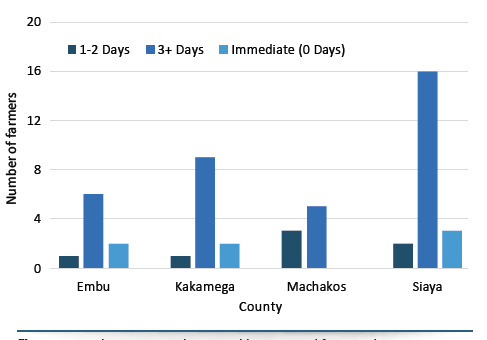
Kenya.
Topographical uniformity despite recognized risk
While 4R principles advocate for the “right place,” spatial implementation remains stagnant. Although farmers acknowledged higher nutrient wash-off on upper slopes, application rates remained uniform across 100% of the surveyed fields (Fig. 2). This common finding of avoiding any practice adjustment for topography indicates that current extension advice does not provide the technical confidence or tools necessary for site-specific placement (Njoroge et al., 2022).
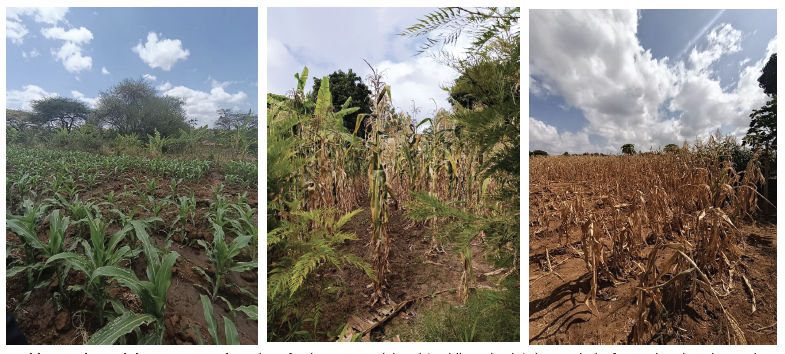
Fig. 2 reveals that the vast majority (80%) of the 50 maize farmers surveyed in Kenya rely on equal distribution, applying fertilizer uniformly regardless of field topography. This “blanket” approach suggests that site-specific nutrient management is not yet a common practice, likely due to labor constraints or a lack of soil-testing resources. Indeed, prior engagements with farmers highlighted soil testing as a key requirement especially in Siaya (Unpublished report). Among the minority who do differentiate, 16% (8 farmers) prioritize upper slopes, most likely to mitigate soil erosion and nutrient loss. Only 4% (2 farmers) expressed a focus on lower slopes, which typically benefit from natural nutrient accumulation via soil and water redeposition and runoff.
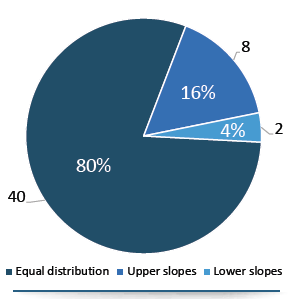
by Kenyan maize farmers according to slope
position in the landscape.
Behavioral response to climate volatility
Drought and stunted growth remain the dominant concerns for 85% of farmers. However, the reliance on traditional weather indicators over digital SMS alerts (used by only 3% of the cohort) suggests that farmers lack “confidence insurance.” In other words, without a mechanism to mitigate the risk of applying expensive nutrients before a potential dry spell, farmers naturally default to conservative, delayed strategies.
Conclusion and call to action
This study’s early findings establish that smallholder nutrient management is trapped between agronomic desire and financial inability. To enhance nutrient use efficiency, 4R recommendations must be transformed into adaptive “moving windows” that incorporate a financial lead time alongside environmental signals and topographical risk factors.
By translating climate and landscape risks into clear, actionable agronomic insights, we can significantly de-risk timely fertilizer financing. When financial institutions and input suppliers are guided by these moving windows, they face vastly lower engagement hurdles, making conditional micro-loans or bundled finance-advisory products highly viable. Ultimately, this diagnostic serves as a foundational framework for developing climate-smart decision support tools that synchronize soil needs with farmer financial solvency, turning the liquidity bottleneck into an opportunity for innovative public-private partnerships.
Mr. Valencia (e-mail: b.valencia@apni.net) is a Spatial AI Analyst based in Benguérir, Morocco. Dr. Adolwa is APNI Scientist based in Nairobi, Kenya. Dr. Okumu is APNI Associate Scientist, Nairobi, Kenya. Mr. Muthamia is APNI Agronomist, Nairobi, Kenya. Dr. Cook is Adjunct Professor, Murdoch University, Perth, Australia. Dr. Oberthür is APNI Business & Partnerships Director, Benguérir, Morocco.
Cite this article
Valencia, B. Adolwa, I.A., Okumu, M., Muthamia, J., Cook, S., Oberthur, T. 2026. Beyond the Rains: Financial Liquidity as a Determinant of 4R Nutrient Timing in Kenya. Growing Africa 5(1): 38-41. https://doi.org/10.55693/GA51.ACYR7316
REFERENCES
Adolwa, I.S., et al. 2026. On-farm experimentation in East and West Africa improves nutrient management decision-making and yield in cereal smallholder farming systems. Agron. J. 118(1), e70276.
Njoroge, S. 2022. 4Rs As an Entry Point for Precision Agriculture in Smallholder Farming Systems of Africa. In, 2nd African Conference on Precision Agriculture, 7-9 December 2022. Nairobi, Kenya. African Plant Nutrition Institute.
Palmer, P.I., et al. 2023. Drivers and impacts of Eastern African rainfall variability. Nat. Rev. Earth & Env. 4(4): 254-270.
Vanlauwe, B., et al. 2010. Integrated Soil Fertility Management: Operational Definition and Consequences for Implementation and Dissemination. Outlook on Agri. 39(1): 17-24.
Zingore, S., et al. 2007. Influence of nutrient management strategies on variability of soil fertility, crop yields and nutrient balances on smallholder farms in Zimbabwe. Agric. Ecosys. Env. 119(1): 112-126.