By Kobusinge Aloys Nyabwisho
Rice is a strategic food and cash crop in Tanzania, but nutrient-poor soils often limit yields. On-farm research in Morogoro’s Dakawa Irrigation Scheme tested how different phosphorus (P) fertilizers and application rates affect lowland rice. The research found that using readily available P sources [especially those that supply nitrogen (N)] boosted rice vigor and grain yield compared with less-soluble rock phosphate.
Research approach
This study was conducted at the Dakawa Irrigation Scheme in Mvomero District, Morogoro, Tanzania, to evaluate the effects of different P sources and application rates on rice growth, yield, and nutrient-use efficiency. The research followed a field-based experimental approach under irrigated conditions, with careful consideration of soil fertility constraints and water management challenges.
Baseline soil tests at Dakawa confirmed severe P deficiency at the study site. The irrigated soils were alkaline (pH 7.6–8.2) with very low plant available P (0.6–1.8 mg/kg) and low organic matter. Electrical conductivity (~650 μS/cm) indicated moderate salinity. Under these conditions, precise P management is critical for raising rice productivity. The experiment compared three P fertilizer treatments, each supplying the same total P but differing in composition. Treatment codes (Table 1) were structured according to fertilizer source, application rate, and replication number. MP refers to Minjingu phosphate rock (28% P, no N), DAP (diammonium phosphate, 46% P, 12% N), TSP (triple superphosphate/Yara Otesha, 29% P, 17% N), while FFO represents the unfertilized control treatment. Fertilizers were applied at recommended P rates in a randomized trial across well-bounded plots. Robust bunds and improved drainage were installed to isolate treatments, preventing runoff and nutrient mixing during the rainy season.
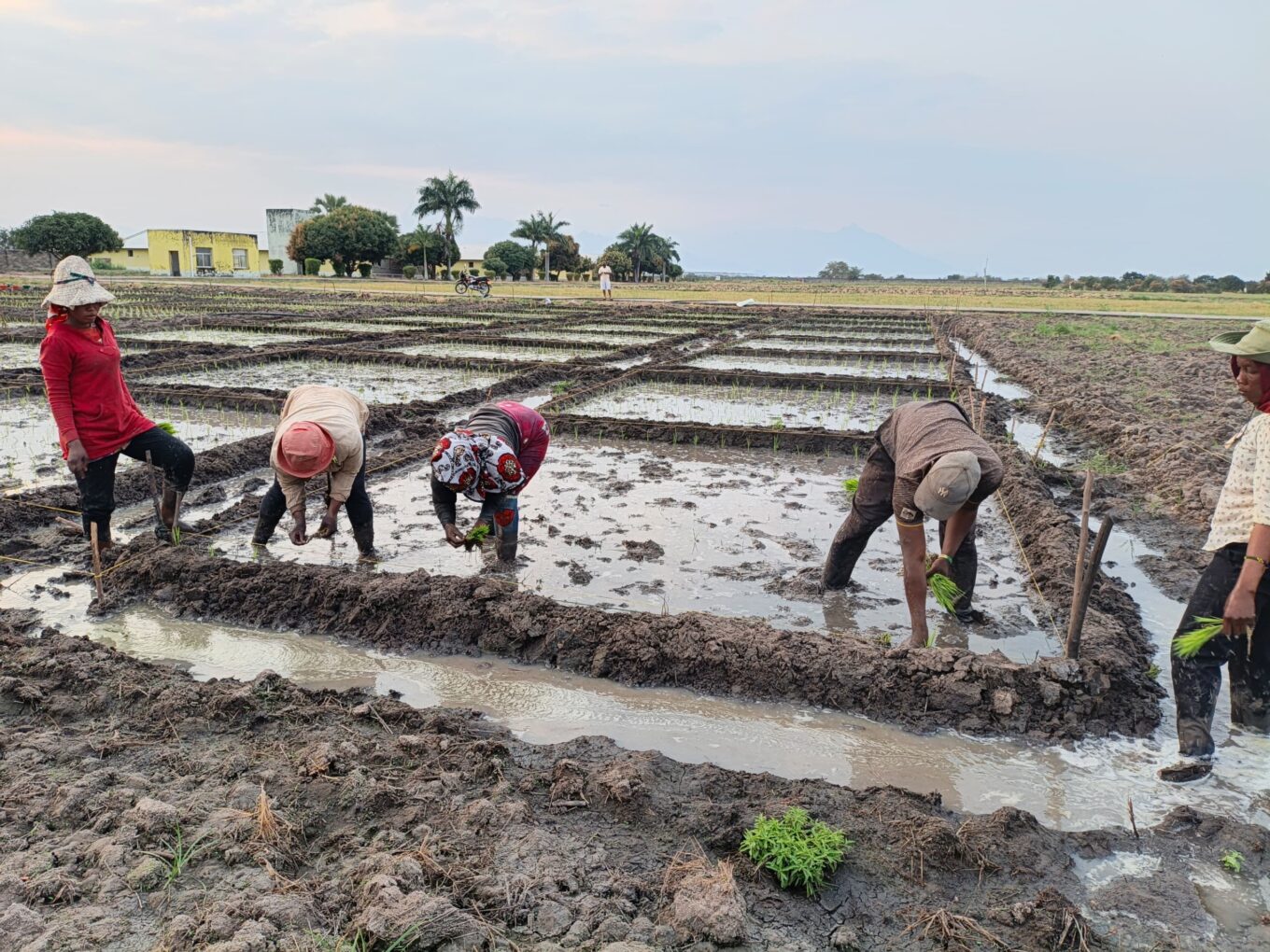
An initial trial (April–July 2025) was discontinued due to uncontrolled water movement that caused nutrient cross-contamination among plots. Based on lessons learned, a second, improved experiment was established in August 2025 at a site with improved irrigation control. Enhanced field management practices, including reinforced bunding, improved drainage, and controlled irrigation channels, were implemented to maintain treatment integrity and prevent nutrient loss.
Rice seedlings were transplanted uniformly across plots, and crop management practices were standardized. Nitrogen application was equalized across all treatments through topdressing to ensure that observed differences were primarily due to P source and rate effects rather than N variability.
Data collection focused on key agronomic parameters, including plant height, tiller number, and grain yield, as well as visual observations of crop vigor and field performance. These data were used to assess treatment effects on rice productivity and to evaluate P use e ffi ciency under irrigated conditions.
Crop performance and field observations
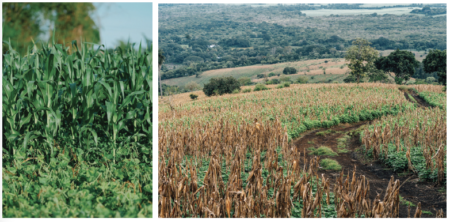
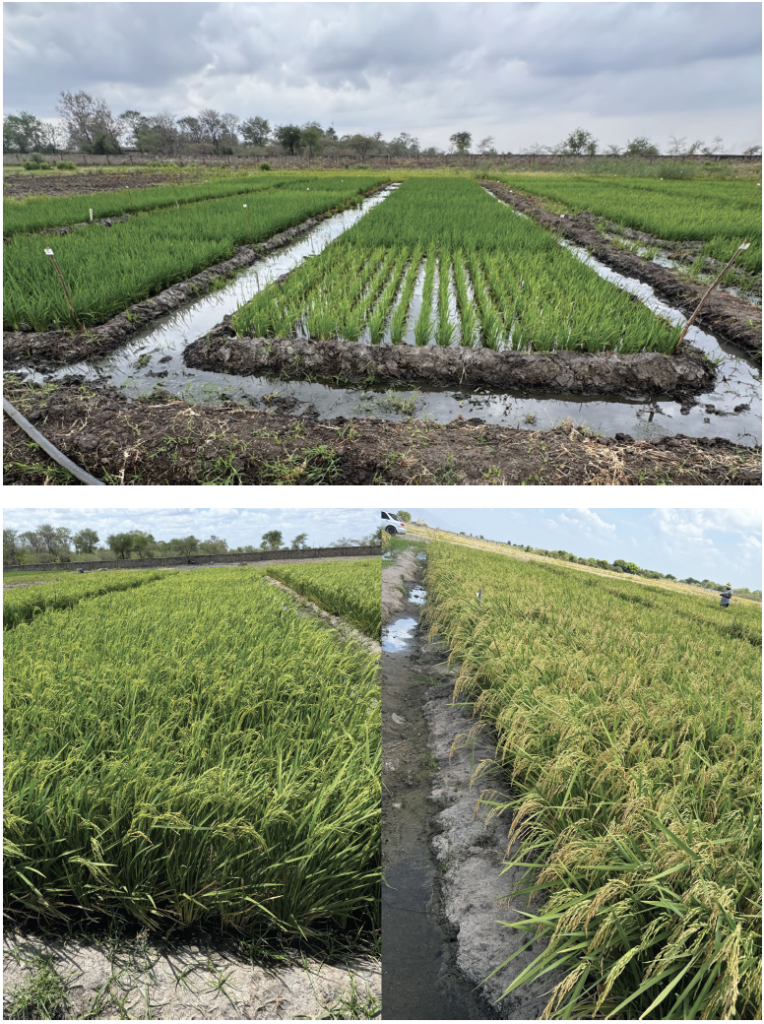
Observations early in the trial highlighted clear treatment differences. By mid-season, plots receiving Yara Otesha TSP showed the most vigorous vegetative growth, while DAP plots were moderately vigorous, and Minjingu PR plots lagged (Fig. 1a). Bunds effectively held water within each treatment, so applied nutrients remained in place. Improved water management ensured uniform crop growth and eliminated nutrient crosscontamination. Differences in plant height, tillering, and canopy development became evident as the crop progressed. These differences were most likely attributed to nutrient solubility and N availability. At flowering and maturity, these differences translated into apparent yield variations among treatments (Fig. 1b).
Effects of phosphorus on growth and yield
By the flowering stage, clear treatment effects were evident in both growth and yield components (Table 1). Phosphorus application showed a distinct advantage over the control, with the 40 kg P/ha rates of DAP and TSP consistently producing the tallest plants and the highest number of tillers. Minjingu rock phosphate (PR) generally recorded comparatively lower growth performance across these parameters.
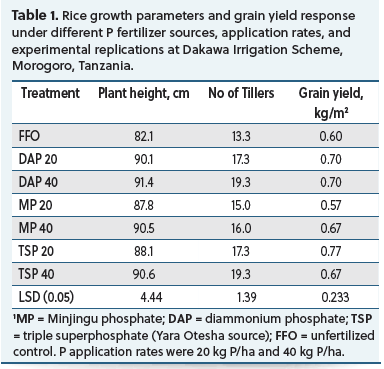
Although grain yield differences were less sharply defined, a consistent trend was observed in which DAP and TSP outperformed PR. Overall, rice plots receiving DAP and TSP, particularly at the higher application rate, tended to achieve superior plant growth and higher yields than those under Minjingu PR or the control.
These responses reflect differences in nutrient availability, where the more soluble TSP and DAP likely provided more readily available P and associated N (in the case of DAP), supporting stronger early vegetative growth and ultimately contributing to improved yield formation compared with the slower releasing PR source.
Data discussion
Treatments receiving readily soluble P fertilizers such as DAP and TSP generally produced greater tillering, plant height, and grain yield compared with Minjingu PR and unfertilized controls. This consistency across replications strengthens the reliability of the observed treatment effects.
A.N. Kobusinge (TARI)/Photo
This superior performance can be attributed to the high solubility and immediate availability of P in TSP and DAP, which enables rapid uptake by rice plants during the early growth stages when nutrient demand is most critical. In addition, both fertilizers supply N alongside P, further enhancing early vegetative growth, tillering, and canopy development.
In contrast, Minjingu PR exhibits slower dissolution and lower short-term P availability, especially under soil conditions that are not sufficiently acidic to facilitate its solubilization. As a result, crops receiving PR may experience delayed nutrient uptake, leading to comparatively reduced early vigor and ultimately lower yield response, particularly within a single growing season.
The divergence in performance becomes more pronounced at higher application rates, suggesting that increasing the quantity of a less soluble P source does not necessarily translate into proportional yield gains unless supported by favorable soil conditions or complementary management practices. This highlights the importance of not only the rate but also the form and timing of fertilizer application in optimizing nutrient-use efficiency.
From an agronomic perspective, these findings reinforce the need for site-specific fertilizer recommendations that consider both fertilizer characteristics and soil properties. While soluble fertilizers such as TSP and DAP are more effective for immediate crop response, especially in intensive irrigated systems, locally available sources like Minjingu PR may still play a valuable role in integrated nutrient management strategies when combined with organic amendments or applied in soils conducive to their gradual release.
Overall, the results emphasize that improving early-season nutrient availability is a key leverage point for enhancing rice Productivity and that fertilizer selection should be aligned with both crop demand and soil conditions to achieve optimal and sustainable outcomes.
Interpretation and implications
The results clearly demonstrate that both the source and rate of P are critical determinants of rice productivity in irrigated systems. Fertilizers that supply both P and N, such as DAP, confer a distinct agronomic advantage during the early stages of crop growth by ensuring immediate nutrient availability at a time when root systems are still developing, and nutrient demand is high. This early nutrient supply enhances seedling vigor, promotes rapid root proliferation, and improves tiller initiation, all of which are key drivers of final grain yield.
The findings underscore the importance of early nutrient dynamics in shaping crop performance. Initial access to both P and N establishes a “nutritional head start,” enabling plants to establish more effectively, capture resources more efficiently, and maintain a competitive advantage throughout the growth cycle. This highlights that nutrient timing, not just total nutrient quantity, is a critical factor influencing nutrient-use efficiency and yield outcomes.
From a soil fertility perspective, the study also implies that P sources with differing solubility and release characteristics must be carefully matched to soil conditions and crop requirements. Readily soluble P sources can meet immediate crop demand, whereas less soluble sources may require appropriate soil conditions (e.g., low pH) or complementary management practices to enhance their effectiveness. Therefore, integrating P sources with organic inputs or adopting site-specific nutrient management strategies can help optimize both short-term crop response and long-term soil fertility.
Practical implications for farmers
To translate these findings into actionable field practices, farmers should adopt P management strategies that maximize early nutrient availability, improve nutrient-use efficiency, and sustain soil fertility over time. The following recommendations are particularly relevant for irrigated rice systems in Tanzania:
1. Prioritize readily available P sources for quick crop response: Farmers are encouraged to use highly soluble P fertilizers (e.g., DAP or blended fertilizers such as Yara Otesha TSP) where immediate crop response is required. These fertilizers dissolve quickly in the soil solution, making P readily accessible to young rice plants during critical early growth stages. This is especially important in soils with low available P, where delayed nutrient supply can limit crop establishment and yield potential. Otherwise, all other P fertilizers should be upgraded to more soluble and quick-release nutrients form that will allow timely uptake by plants.
2. Use balanced fertilizers that supply both P and N: Fertilizers that provide both P and N offer a strategic advantage by supporting early vegetative growth and root development simultaneously. This dual nutrient supply enhances seedling vigor, promotes effective tillering, and improves canopy formation. Farmers should consider applying such fertilizers as basal or starter applications, followed by appropriate top-dressing of N later in the season to sustain crop growth.
3. Apply adequate P rates based on soil fertility status: In P-deficient soils, applying sufficient P is essential to achieve optimal yields. As a general guideline, a rate of at least 40 kg P/ha is recommended, though exact rates should ideally be guided by soil testing. Underapplication can limit crop performance, while over-application may be economically inefficient and environmentally unsustainable. Site-specific recommendations should therefore be promoted through extension services.
4. Improve water management to enhance nutrient efficiency: Effective field water management is critical for optimizing P availability and uptake. Farmers should ensure proper field leveling, strong bunding, and well-maintained drainage systems to regulate water flow and reduce nutrient losses through runoff or leaching. Controlled irrigation not only supports better nutrient use but also improves root health and overall crop performance.
5. Integrate organic inputs where possible: Although not a substitute for mineral fertilizers in the short term, incorporating organic materials such as farmyard manure or compost can improve soil structure, increase microbial activity, and enhance long-term P availability. Combining organic and inorganic nutrient sources supports sustainable soil fertility management and reduces dependency on external inputs over time.
6. Adopt timely and proper fertilizer application practices: Applying P at the right time (preferably at planting or shortly after) and using appropriate placement methods (e.g., banding or incorporation into the soil) can significantly improve fertilizer efficiency. Proper timing ensures that nutrients are available when the crop needs them most, particularly during early root development.
Conclusion
Optimizing P management is fundamental to enhancing rice productivity and sustainability in Tanzania’s irrigated production systems, particularly in schemes such as Dakawa, where soil constraints and nutrient imbalances are prevalent. This study demonstrates that rice yield response is not determined by P application alone, but by the interaction between fertilizer type, soil physicochemical properties, nutrient availability, and field-level management practices, including water control and residue management.
The findings highlight that the choice of P source, whether soluble fertilizers such as DAP or locally available materials like Minjingu PR, must be aligned with site-specific soil conditions, especially soil pH, organic matter content, and inherent P status. Efficient P use is further enhanced when combined with integrated nutrient management strategies that incorporate organic amendments, which improve soil structure, microbial activity, and long-term nutrient cycling.
Moreover, improved field management practices, particularly water management in irrigated rice systems, play a critical role in regulating P dynamics, availability, and uptake. Practices such as proper land leveling, controlled irrigation, and timely application of inputs can significantly increase P-use efficiency while reducing losses through runoff or fixation.
From a broader perspective, optimizing P management contributes not only to increased yields but also to improved soil health, reduced production costs, and minimized environmental risks associated with nutrient mismanagement.Therefore, promoting site-specific, integrated, and knowledge-based P management strategies should be a priority for research, extension services, and policy interventions in Tanzania. These efforts will support sustainable intensification of rice systems, enhance farmer resilience, and contribute to national food security goals.
The implications for agronomic practice and policy are significant. Farmers and extension services should prioritize balanced and timely nutrient application strategies that ensure adequate early-season availability of both P and N. This may involve promoting starter fertilizers, improving recommendations on fertilizer timing and placement, and encouraging integrated nutrient management approaches that combine mineral fertilizers with organic amendments. Such strategies can enhance nutrient-use efficiency, increase productivity, and reduce the risk of nutrient losses to the environment.
Future Work
Future research should expand beyond singleseason evaluations to multi-season and multi-location trials in key rice-growing agro-ecologies of Tanzania. This will allow for a more robust assessment of P dynamics under varying climatic conditions, soil types, and water management regimes, thereby improving the reliability and scalability of fertilizer recommendations. Long-term trials will also help capture residual effects of different P sources, particularly less soluble materials such as phosphate rocks, and their contribution to building soil P capital over time.
Further work needs to focus on refining site-specific nutrient management strategies by integrating deep-scale soil testing, crop response data, and decision-support tools. This includes calibrating economically optimal P rates, evaluating combinations of mineral fertilizers with organic inputs, and assessing the interactions between P, N, and other essential nutrients under irrigated rice systems. Emphasis will also be placed on understanding the role of soil properties such as pH, texture, and organic matter in influencing P availability and fertilizer efficiency.
In addition, future studies should incorporate socio-economic analyses to evaluate the cost effectiveness, affordability, and adoption potential of different P management options for smallholder farmers. This will ensure that recommendations are not only agronomically sound but also practical and accessible within local farming contexts. Participatory on-farm trials and co-creation approaches with farmers will be essential to validate technologies under real world conditions and enhance uptake.
Dr. Nyabwisho (e-mail: kobukajani@gmail.com) is Senior Research Officer, Tanzania Agricultural Research Institute (TARI), Morogoro Region, Tanzania.
Acknowledgement
The author gratefully acknowledges the financial and technical support provided by the African Plant Nutrition Institute through the African Phosphorus Fellowship Award, which made this research possible. This support has significantly contributed to advancing knowledge on P management in rice-based systems and strengthening capacity in soil fertility research in Tanzania. The author also extends sincere appreciation to the Tanzania Agricultural Research Institute, particularly the Dakawa Research Centre, for providing the institutional framework, field facilities, and technical assistance necessary for the successful implementation of this study. Special thanks are due to fellow researchers, field technicians, and laboratory staff for their dedication to data collection, sample processing, and analysis. Gratitude is further extended to collaborating farmers and stakeholders within the Dakawa Irrigation Scheme for their cooperation, field access, and valuable local knowledge, which enriched both the implementation and relevance of this research. Their participation underscores the importance of participatory approaches in developing practical and scalable soil fertility management strategies. Finally, the author acknowledges all individuals and institutions whose contributions, whether directly or indirectly, supported the successful completion of this work.
Cite this article
Nyabwisho, K. 2026. Optimizing Phosphorus Application Strategies for Rice Production in Tanzania. Growing Africa 5(1):11-16. https://doi.org/10.55693/GA51.YGCY3779
REFERENCES
Massawe, P.I., Mrema, J. 2018. Effects of different phosphorus sources and application rates on soil residual N and P in the rice field. Adv. Plants & Agric. Res. 8.
Massawe, P.I., Mrema, J. 2017. Effects of different phosphorus fertilizers on rice yield components and grain yields. Asian J. Adv. Agric. Res. 3. 1-13.
Opala, P.A. 2023. The use of phosphate rocks in East Africa: A Review. Agricultural Reviews.
Msaky, J.J.T., Msanya, B.M., Uriyo, A.P. 1986. The use of rock phosphate as a source of phosphorus on a slightly acid clayey soil in Tanzania. Afrika Focus 2.
Rakotoson, T., Tsujimoto, Y., Nishigaki, T. 2022. Phosphorus management strategies to increase lowland rice yields in sub-Saharan Africa: A review. Field Crops Res. 275.