GENDER AND PRECISION AGRICULTURE IN AFRICA: PART 2
By Pamela Pali, Shamie Zingore, Thomas Oberthür, and Amy Sullivan
By advancing from gender-responsive to gender-transformative strategies, programs can address structural inequalities, enhance women’s decision-making power, and improve adoption of innovations. The role of partnerships and evidence-based monitoring in achieving inclusive, productive, and sustainable agricultural systems in Africa are critical.
Importance of gender in precision agriculture
Integrating gender into Precision Agriculture (PA) is crucial for maximizing its effectiveness, inclusiveness, and sustainability. Ignoring gender risks developing technologies that primarily benefit a subset of farmers, limiting adoption, reducing productivity gains, reinforcing inequalities, and undermining the scalability and impact of PA interventions. Gender integration is both an equity imperative and a strategic investment that enhances the economic returns of PA. Evidence suggests that if women farmers had equal access to productive resources, technologies, finance, extension services, and training as men, their yields could increase by 20–30%, raising agricultural production in developing countries by 2.5–4% and reducing global hunger by an estimated 100–150 million (M) people (FAO, 2011). Beyond productivity, women’s economic empowerment generates wider development benefits, as they are more likely than men to invest additional income in household nutrition, healthcare, and children’s education, strengthening human capital and long-term growth.
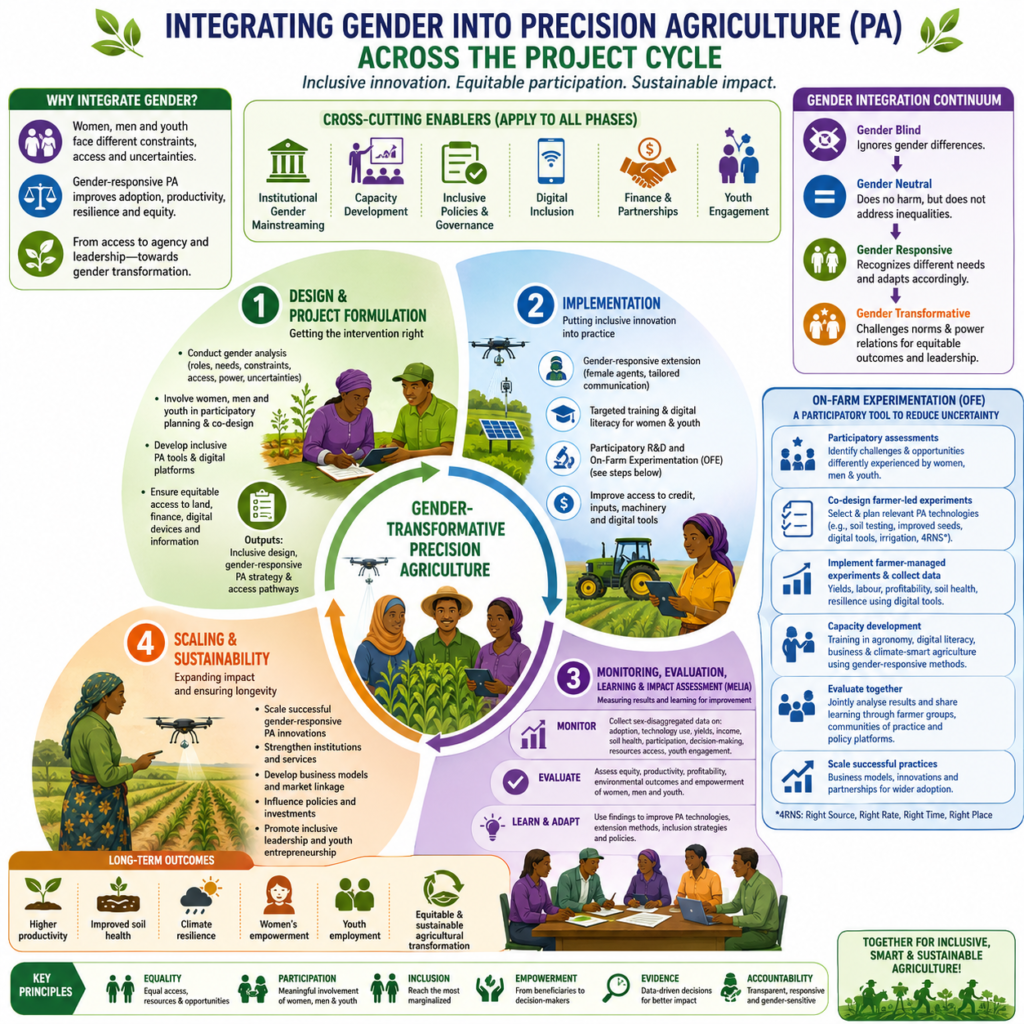
Yet women remain underrepresented across agricultural value chains, comprising only 5–10% of agribusiness owners, with participation often confined to farm production rather than higher value activities such as marketing, processing, and enterprise development. Expanding women’s and youth’s participation in agribusiness, digital agriculture, and other high-value segments of PA offers a practical pathway to reduce structural constraints, improve access to markets and finance, strengthen decision-making, and promote entrepreneurship. Embedding gender responsive approaches throughout the PA project cycle thus enhances technology adoption, productivity, household welfare, resilience, and inclusive economic growth, while ensuring that precision agriculture contributes to equitable, sustainable, and transformative agricultural development. According to UNIDO (2021), gender mainstreaming into the research project cycle requires adequate design, implementation, monitoring and evaluation, and scaled interventions that recognize the different roles, constraints, and opportunities of women, men, and youth throughout the agricultural production cycle. Fig. 1 illustrates how gender considerations can be integrated across the PA project cycle.
A. Project design
Gender integration begins during project formulation. A gender analysis should identify the roles and needs of women, men, and youth and addresses any gender inequalities so that women, men, and youth can equally access, participate in, and benefit from the resources, services, capacity development, and other activities offered by the project. Examples include:
(i) Inclusive technology design: Developing PA tools and platforms that address the specific needs and constraints of women and youth farmers, ensuring usability regardless of literacy or digital skills and physical limitations, thereby removing barriers that might otherwise limit women’s and youth’s effective use of PA innovations.
(ii) Participatory approaches: Gender analysis is used to involve both women and men in the identification, design, implementation, and evaluation of PA projects. Gender analysis will determine the key issues in the PA project and how the project or program affects women, men, and youth differently.
(iii) Improved access to resources: Promoting gender equitable access to land, credit, digital devices and information. This can be achieved through policy reforms, targeted subsidies and partnerships with financial institutions.
Institutional gender mainstreaming within organizational processes (i.e., leadership roles, policy development, and accountability mechanisms) are important. Stakeholder capacity development (i.e. training policymakers, researchers, and extension agents) is also critical to applying a gender lens to their work, ensuring that gender-responsive PA becomes standard practice.
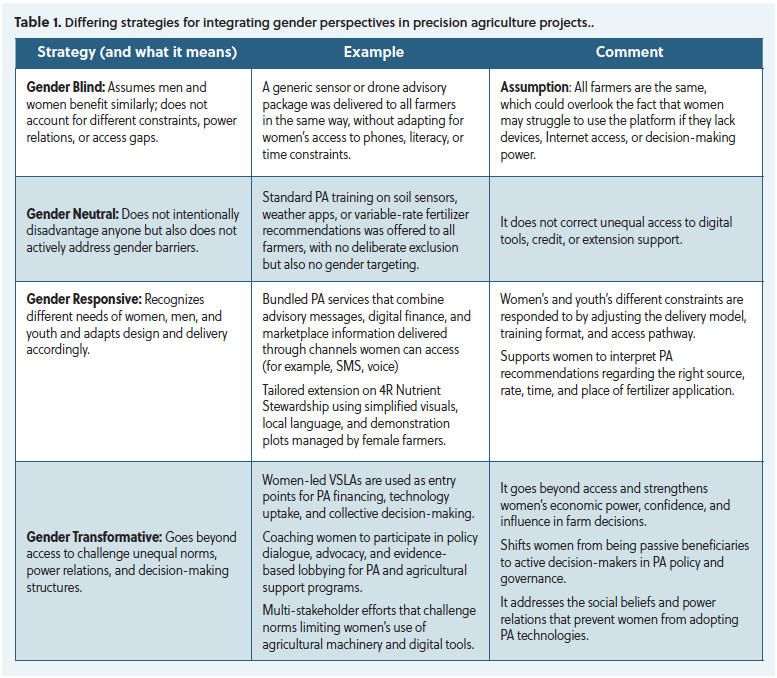
To ensure this during the design phase, a gender analysis can be conducted to understand how the PA intervention will affect gender at the community or household level. This will support the understanding of how the PA intervention will integrate gender into the project with consideration of understanding the uncertainties faced by women, men, and youth as posed by the intervention (Table 1).
B. Project implementation
Successful implementation depends on ensuring that women, men, and youth can equally access project resources and services, participate in project activities and decision-making processes, and benefit equally from capacity development activities offered by the project, including the following:
(i) Targeted training and extension services to increase women’s access to extension services and training using gender-responsive methods, such as female trainers and tailored communication channels. This helps overcome barriers related to social norms and to limited mobility.
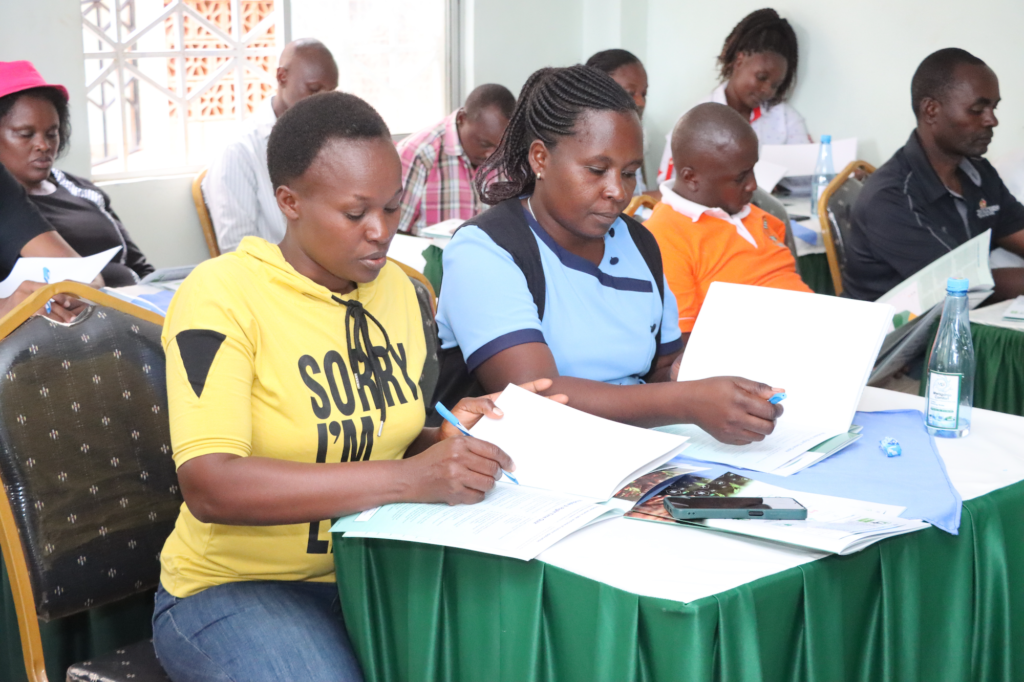
(ii) Participatory R&D programs and methods that ensure that women’s preferences and challenges are considered, leading to higher adoption and impact. This includes integrating on-farm experimentation (OFE) or farmer-led experimentation that empowers farmers—particularly women and youth—to test and adapt technologies in their own contexts, fostering practical learning and enhancing technology relevance and adoption. OFE is a participatory, multi-actor, real-world experimentation approach which supports inclusive PA that is farmer-driven and participatory, conducted through co-learning between farmers and experts, and designed to generate locally relevant and scalable knowledge. OFE can be explicitly positioned as a participatory tool to reduce uncertainty (how variables interact locally) in a way that inherently avoids Translational Uncertainty (because the woman tests it herself, in her own context). It comprises distinct steps which provide opportunities for gender integration. Participatory assessments should be conducted to identify farming challenges and opportunities. Women, youth, and men often experience different constraints related to land access, labor, finance, technology, and decision-making. Understanding these differences helps tailor PA solutions to local conditions.
(iii) Co-designed farmer-led experiments to involve women and youth in planning farmer-led experimentation ensures that technologies are relevant, accessible, and acceptable to all users. Technologies such as soil testing, improved seeds, digital advisory tools, irrigation technologies, and climate-smart practices can be evaluated. Site-specific fertilizer recommendations can be developed using the 4R Nutrient Stewardship (4RNS) framework, which showcases the levels of change in gender-transformational approaches implemented in the program.
(iv) Implement farmer-managed experiments and collect data on yields, labor use, profitability, soil health, resilience, etc. Digital tools, mobile applications, and sensors can support monitoring and decision-making. Youth can contribute as technology service providers, data collectors and digital extension agents.
(v) Conduct capacity development providing farmers with required training in agronomy, digital literacy, business skills, climate-smart agriculture, etc. Gender-responsive training methods help overcome barriers limiting women and youth participation.
(vi) Joint evaluation of results shared through farmer groups, extension systems, and policy platforms using forums such as post-harvest dialogues, communities of practice, and policy dialogues.
(vii) Scaling successful practices through business case development models can improve productivity, reduce labor burdens, create youth employment opportunities, and strengthen the equitable participation of women, youth, and men in sustainable agricultural transformation.
C. Monitoring and evaluation
Gender integration ensures that women and men equally participate in monitoring and evaluation activities and decision-making processes. Data can be collected on women and men so that gender impacts are tracked to assess whether the PA project equally benefits women and men. Collecting sex-disaggregated data and regularly assessing the gender impacts of PA interventions will guide how starting strategies can be adapted to close gaps in project design and implementation.
The importance of multi-stakeholder collaboration and support
Multi-stakeholder partnerships between government agencies, NGOs, and private sector organizations enable the pooling of financial, technical, and human resources to develop and deliver solutions tailored to female, male, and youth farmers’ needs. For example, bundled digital solutions, such as advisory services, digital finance, and online marketplaces can address the multiple barriers women face, but these require collaboration across sectors for effective implementation. Thus, joint initiatives can ensure that agricultural technologies and programs are designed with a gender lens that addresses the social and structural barriers unique to women. This includes developing gender strategies, setting targets for women’s participation, and designing interventions that consider local norms and realities.
Partnerships with financial institutions and agribusinesses encourage innovative financing models, such as collateral-free loans based on production history, and facilitate digital payment systems, making it easier for women and youth to access and repay these loans. For example, collaborative support to community Village Savings Loan Associations (VSLA’s) can provide a starting point for credit support to female farmers, as they comprise the largest membership in these organizations (IERC, 2021). Women-led VSLAs have been shown to improve women’s economic status, social empowerment, and decision-making power in households and communities.
NGOs and government agencies working together can strengthen extension services and training programs, ensuring that women receive relevant information and support and building their skills to adopt new technologies. Multi-stakeholder efforts help to address deep-rooted gender norms by promoting women’s leadership, participation in decision-making, and visibility in agricultural value chains.
Policy development processes also need to play a role. Coaching is required to enable women to better participate in policy dialogue alongside their male counterparts, who currently dominate the discussion, to teach women how to advocate, how to use evidence-based lobbying, how to be persuasive, and to have the confidence to conduct policy dialogue.
Dr. Pali (e-mail: p.pali@apni.net) is an APNI Senior Scientist, Nairobi, Kenya. Dr. Zingore is APNI R&D Director, Benguérir, Morocco. Dr. Oberthür is Business & Partnerships Director, Benguérir. Dr. Sullivan is Consultant for Gender, Water & Natural Resource-Based Livelihood Systems in Asia & Africa, Pretoria, South Africa.
Cite this article
Pali, P., Zingore, S., Oberthür, T., Sullivan, A. 2026. Gender and Precision Agriculture in Africa. Part 2: Integrating Gender Sensitive Approaches into Precision Agriculture Programming. Growing Africa 5(1):19-23. https://doi.org/10.55693/GA51.ZGPQ4276
REFERENCES
FAO. 2011. The state of food and agriculture 2010–2011: Women in agriculture—Closing the gender gap for development. https://www.fao.org/4/i2050e/i2050e.pdf
IERC. 2021. Women’s Leadership in VSLAs in Uganda: Findings from a cross-sectional survey. © AVSI, BRAC, Care Uganda; Makerere University, The Africa Centre and Village Enterprise. https://bigd.bracu.ac.bd/wp-content/uploads/2021/11/Findings-of-VSLA-cross-sectional-survey-UG-2021.pdf
UNIDO Gender. 2021. UNIDO gender analysis and mainstreaming in the project cycle. https://www.unido.org/sites/default/files/unido-publications/2024-03/UNIDO_Guide_to_Gender_Analysis_and%20Gender_Mainstreaming_in_Project_Cycle.pdf.