By Esther Mugi-Ngenga, William Adzawla, Pamela Pali, Brayan Valencia, Shamie Zingore, and Thomas Oberthür
Legume-based systems can drive sustainable intensification in sub-Saharan Africa (SSA), but their success, especially with legume–cereal integration and phosphorus (P) fertilization, is constrained by market access Using baseline data from 1,064 households in Ghana, Tanzania, and Malawi, this study assesses readiness to achieve productivity, nutrient use, and economic targets under Legume-Driven Intensification (LDI). Results show strong spatial variation: Tanzania relies more on intercropping but has very low fertilizer adoption (6%), while Malawi shows higher readiness (46%). Increasing distance from markets reduces commercialization and economic viability. Overall, market access critically shapes outcomes, highlighting the need for localized input delivery and spatially targeted strategies to enable effective scaling of LDI interventions.
Legume-based production systems provide multiple benefits, including improved soil fertility, higher yields, enhanced food and nutritional security, increased incomes, and greater resilience among farming households in Africa. They also deliver a range of ecosystem services, such as diversified nutrition for humans and livestock, conservation of agrobiodiversity, and enhanced climate resilience (Tesfai et al., 2019). As such, they are essential for sustainable intensification and food system transformation (Phiri et al., 2024). Specifically, crop yields can increase by 30-35%, nutrient-use efficiency by 25-30%, and the impacts of pests and diseases on yields can be reduced by 20-25% under legume intercropping systems (Akchaya et al., 2025). In addition, legume-based cropping systems enhance soil carbon (C) and nitrogen (N) stocks, reduce bulk density, and improve soil cation exchange capacity (Ananda et al., 2022). Consequently, these production systems offer a promising approach to addressing substantial yield gaps and accelerating sustainable agricultural production.
To move beyond subsistence agriculture and address severe soil nutrient deficiencies, modern legume-driven intensification requires a transition to an optimized genotype x environment x management (G x E x M) framework. Central to this transition is the strategic implementation of 4R Nutrient Stewardship (Right Source, Right Rate, Right Time, and Right Placement) (APNI, 2021; Johnston and Bruulsema, 2014), particularly with targeted P fertilizers. Such an approach can maximize biological N fixation, reduce use of C-intensive nitrogen (N) fertilizers, and improve economic returns. However, the successful adoption and scaling of this strategy depends heavily on the socioeconomic environment, particularly the transaction costs associated with a farmer’s physical distance from agricultural input and output markets.
The availability of and access to efficient output markets are critical catalysts and moderating factors in legume-based production systems. The von Thünen location theory (von Thünen, 1826) posits that agricultural land use is distributed according to distance from a central market and the associated transportation costs. These factors determine land rents, influence crop allocation decisions, and create concentric production zones (Park, 1996; Kellerman, 1989; von Thünen, 1826). The adoption and intensity of legume production are strongly influenced by market access (Barnes et al., 2026). Output markets shape food systems by serving as hubs for agricultural information, facilitating access to improved inputs, incentivizing the cultivation of high-value crops and market-oriented production, enhancing productivity, and reducing post-harvest losses. Collectively, these factors contribute to improved livelihood outcomes, including higher incomes, enhanced food security, and reduced poverty. Conversely, limited market access increases input costs through higher transaction costs and reduces the effective prices farmers receive for their produce. Connecting farmers to markets is widely recognized as a key pathway for agricultural development and for achieving the Sustainable Development Goals (SDGs), particularly SDG 1 (No Poverty) and SDG 2 (Zero Hunger) (Villar et al., 2023), while also supporting broader rural economic development. Improving access to both markets and productivity-enhancing inputs, such as P fertilizers, is among the most promising strategies for enhancing household dietary diversity (Koppmair et al., 2017).
Despite these opportunities, access to output markets remains limited across SSA due to resource constraints, high transaction costs, remoteness, information asymmetries, and limited business skills among farmers (Ma et al., 2024; Otekunrin et al., 2019; Jebesa, 2019; Stifel and Minten, 2017). In Ghana, for example, weak market integration and limited market linkages continue to constrain smallholder farmers, including women and youth (Annaful and Annan, 2025). Similarly, in Malawi, market opportunities for legumes have declined due to unfavorable and inefficient trade policies (Kakwera et al., 2025). Beyond the limited policy support for legume-based intercropping, markets for legumes remain underdeveloped (Tesfai et al., 2019). These challenges can trap smallholder farmers in cycles of low productivity, low income, and persistent poverty. Although agricultural markets in SSA are undergoing rapid transformation, the physical distance between production sites and market hubs remains a critical determinant of economic development and food security at both regional and national levels.
To establish a contextual baseline, this study hypothesizes that proximity to output markets positively influences baseline commercialization and initial fertilizer adoption. Consequently, a farm’s distance from markets is expected to act as a primary moderator of the likelihood of achieving targeted improvements in Total System Productivity (measured by the Land Equivalent Ratio, LER), P-fertilizer adoption, and economic viability (defined as a benefit-cost ratio [BCR] > 2). Accordingly, the specific objectives of this study are to:
(1) assess the initial readiness for targeted LER improvements by mapping baseline cropping systems along market-distance gradients;
(2) evaluate spatial constraints on existing fertilizer use as an indicator of the likelihood of achieving the target of 15% P-fertilizer adoption; and
(3) analyze commercial production orientations to assess the geographic risks associated with achieving the economic viability targets of legume intensification.
Study area
Research study was conducted across three country corridors representing distinct agroecological and market contexts in SSA (Table 1). In Ghana, the study corridor included the Central Gonja District in the Savannah Region and the Kintampo North District in the Bono East Region. These adjacent districts are located within the Guinea Savannah and Transitional agroecological zones. Average annual rainfall ranges from approximately 1,100 mm in Central Gonja to between 1,100 and 1,500 mm in Kintampo North, with most rainfall occurring between May and October. While both districts are predominantly agrarian, Kintampo North is less urbanized than Central Gonja, with urbanization rates of 58.6% and 70.5%, respectively. Population densities are approximately 27 and 17 persons/km., respectively (City Population, 2021). The two districts are well connected by a motorable road network, which facilitates market access and commercialization. Crop production is the primary livelihood activity, with groundnut, cowpea, and soybean being the principal legume crops.
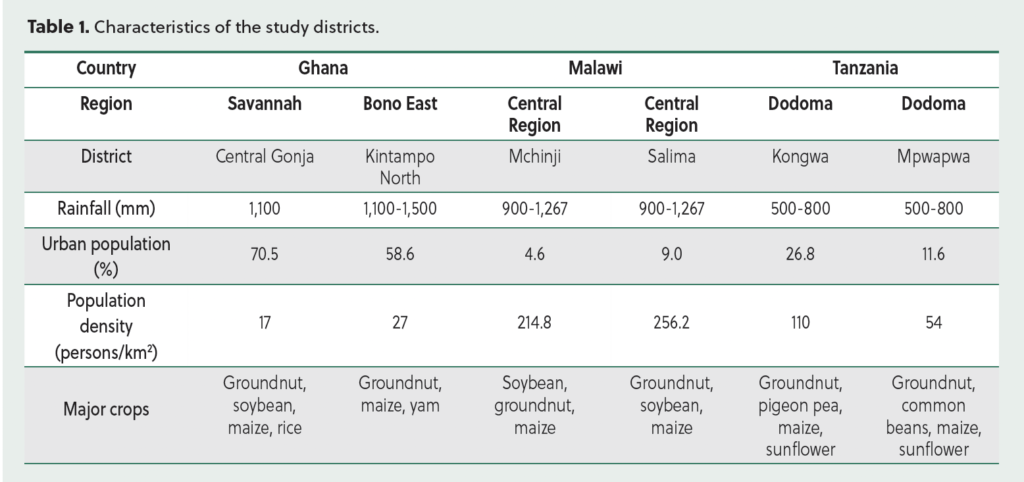
In Tanzania, the study was conducted in the Kongwa and Mpwapwa districts of the Dodoma Region. The area has a semi-arid climate, receiving between 500 and 800 mm of rainfall annually, and is characterized by bushland and thicket vegetation, with a substantial proportion of land under cultivation. The population is predominantly rural. Kongwa is considerably more densely populated than Mpwapwa (110 vs. 54 persons/km.) and has a higher urbanization rate (26.8% compared with 11.6%) (City Population, 2022a, 2022b). Most households engage in the cultivation of crops such as groundnut, millet, and maize, alongside livestock production. The legume subsector is constrained by the limited availability of input suppliers in many villages, making it difficult for farmers to access improved seed, fertilizers, and crop protection products. In addition, road infrastructure is often poor, particularly during the rainy season, limiting farmers’ ability to transport legumes to collection points and markets. These constraints reduce both the quantity and quality of legume production, making it difficult for traders and processors to secure reliable supplies for competitive markets.
In Malawi, households were surveyed in the Mchinji and Salima districts of the Central Region. The districts receive approximately 900 mm and 1,267 mm of annual rainfall, respectively. Population density is relatively high, with Salima being more densely populated than Mchinji (256.2 vs. 214.8 persons/km.). Salima also has a higher urbanization rate (9.0%) than Mchinji (4.6%) (City Population, 2023). Compared with the study areas in Ghana and Tanzania, these districts have shorter road networks. The Central Region is one of Malawi’s major agricultural zones and has strong potential for both cash crops, such as tobacco, and food crops, including maize and legumes. Cowpea, groundnut, and soybean are the principal legume crops grown for both household consumption and income generation. Legume products are marketed through both formal and informal channels, with informal markets being particularly widespread across districts and rural trading centers. However, the sector faces several production and marketing challenges, including inadequate extension services and inefficiencies in market systems, such as farmers’ inability to consistently meet consumer quality and specification requirements. Household survey data and analysis Primary data was collected through structured household surveys administered to 352 farm households in Ghana, 351 in Tanzania, and 361 in Malawi (N = 1,064). The surveys captured plot-level characteristics, including farm size (ha), crop type, yield (t/ha), fertilizer application status, farming orientation (subsistence versus commercial), food security status, and self-reported travel time from the homestead to the nearest market. In this analysis, physical distance to the nearest output market was used as a measurable proxy for assessing baseline constraints on input adoption and production orientation.
However, we acknowledge that market access is inherently multidimensional, and that physical distance often interacts with other critical factors, including transportation costs, infrastructure quality, and institutional conditions, to determine the degree of market integration. These primary data provide a spatially explicit analytical framework to assess the likelihood of achieving targeted agronomic and economic key performance indicators (KPIs). The data were analyzed descriptively and are presented using summary statistics and graphical visualizations.
Implications of market distance on production orientation
Farmers’ production orientation is shaped by the availability of and access to output markets (Figs. 1 and 2). Decisions regarding input use, crop selection, production systems, scale of operation, enterprise specialization, and level of intensification are associated with the availability of reliable, accessible, and efficient output markets. For example, access to profitable markets can determine whether farmers produce primarily for subsistence or commercial purposes. Similarly, the presence of accessible markets can encourage the adoption of inputs (e.g., improved seeds and fertilizers) and modern technologies, promote the cultivation of high-value and marketpreferred crops, and stimulate production expansion to meet market demand. The data show that, during the five years preceding data collection, most farmers had access to a ready market for their grain legumes. Specifically, 92.0%, 66.8%, and 54.7% of farmers in Ghana, Malawi, and Tanzania, respectively, reported having access to a ready market. Despite this, market distance is associated with the extent to which market access translates into changes in production orientation and outcomes. On average, the nearest output market was located 12.3 km, 5.7 km, and 22.6 km from farmers’ homes in Ghana, Malawi, and Tanzania, respectively. The relatively long average market distance in Tanzania may partly explain the lower level of market access reported by farmers over the preceding five years. In contrast, the relatively short market distance in Malawi is likely associated with the country’s smaller land area, which may place markets and other social infrastructure closer to farming communities. Below, we map baseline cropping systems, fertilizer use, and commercial production orientations along market-distance gradients to evaluate initial readiness for legume-driven intensification and to assess the geographic risks associated with achieving the LDI’s KPIs.
Market distance is generally negatively associated with production intensity, although the nature and strength of this relationship vary across local contexts, including transportation systems, market structures, and production objectives. A clearer picture of this association emerges when examining the median distribution of production scale across the three countries (Fig. 1A). In Ghana, most farmers cultivating less than 2 ha and between 2 and 5 ha are located beyond their respective group median distances, whereas those cultivating more than 5 ha are more evenly distributed around the median. Despite these differences, monocropping remains the dominant production system, while crop rotation is concentrated among farmers located 2-10 km from markets (Fig. 1B). In Malawi, farms are generally smaller and exhibit an uneven distribution across production scales. Most farmers cultivating between 0 and 5 ha are located below the median market distance, whereas those cultivating more than 5 ha tend to be located farther from the median distance (Fig. 1A). Monocropping is also widespread in Malawi; however, farmers located farther from markets tend to shift from crop rotation toward intercropping systems (Fig. 1B). In Tanzania, where many farmers are located relatively far from markets, intercropping is widely practiced regardless of market distance (Fig. 1B). This predominance of intercropping suggests a higher baseline readiness to achieve targeted improvements in Total System Productivity (LER). The relatively few farmers practicing crop rotation tend to be located closer to markets.
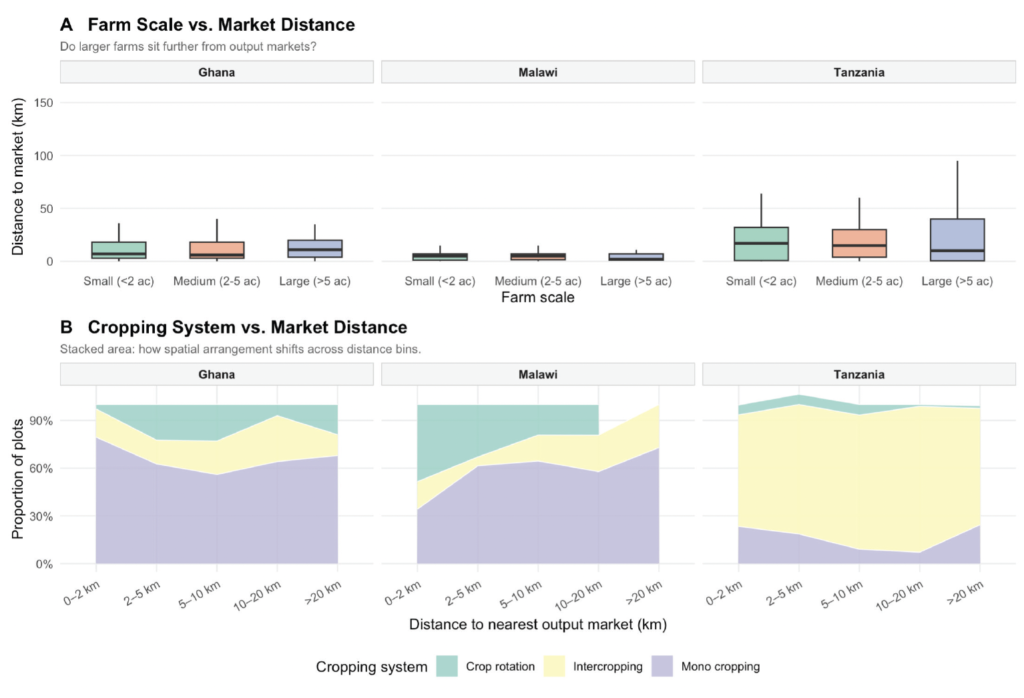
Overall, the relationships among market distance, production scale, and cropping systems are highly context-specific. This suggests that local factors—including agroecological conditions, transportation infrastructure, market development, and institutional arrangements—play important roles in moderating the influence of market distance on production decisions and intensification pathways.
Because the adoption of fertilizers depends on both the availability of functioning input supply chains and farmers’ willingness to invest in soil fertility management, the existing spatial patterns of inorganic fertilizer use (Fig. 2A) provide a useful baseline proxy for assessing a community’s readiness to adopt targeted P-fertilizers under the 4R Nutrient Stewardship framework. The primary nutrients supplied by fertilizers were N and P, although a small number of farmers, particularly in Ghana, applied fertilizers containing additional nutrients such as sulfur (S) and zinc (Zn). In Ghana, most farmers using inorganic fertilizers were located relatively close to markets (Fig. 2A). In Malawi, the median market distance was similar for both fertilizer users and non-users. However, most farmers applying fertilizer were located within 10 km of a market. This suggests that while market access may not strongly influence the decision to use fertilizer, it is associated with application intensity, likely because transportation costs affect the affordability and accessibility of inputs. The results for Tanzania differ markedly from those of Ghana and Malawi. Despite the relatively low prevalence of fertilizer use, fertilizer users were generally located closer to markets, at an average distance of approximately 2 km. Overall, these findings indicate that the relationship between market access and fertilizer use is context-specific. Market-related constraints appear to limit fertilizer adoption readiness more severely in Tanzania than in Malawi and Ghana.
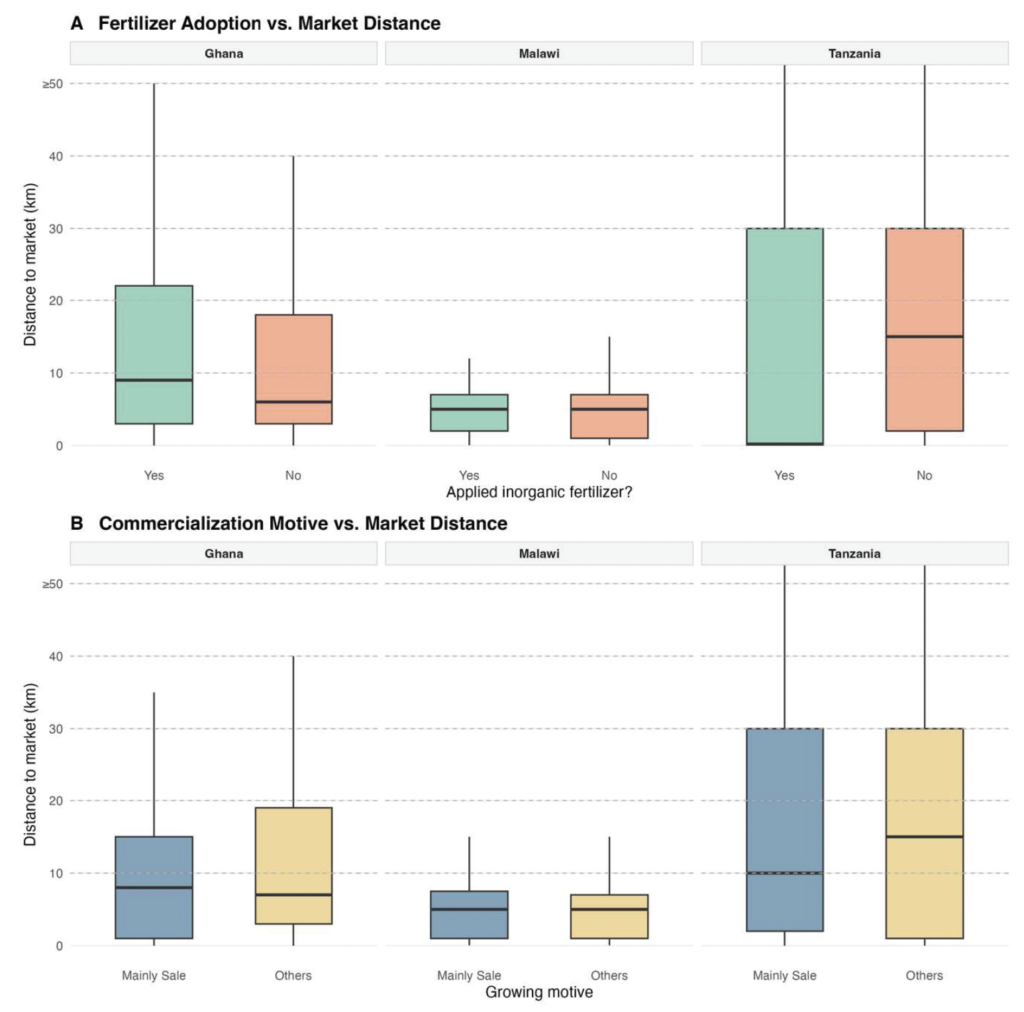
Farmers engaged in legume production primarily for commercial purposes generally exhibited median market distances like those producing for subsistence or other purposes, with the notable exception of Tanzania (Fig. 2B). In Ghana, farmers with a predominantly commercial orientation were distributed relatively evenly around the median market distance, whereas those producing mainly for subsistence or other purposes were concentrated beyond the median distance. In Malawi, the distribution of both groups was generally skewed toward locations below the median market distance. In Tanzania, commercially oriented farmers were located at shorter median distances from markets, although some were situated considerably farther away. Importantly, the clustering of farmers with a predominantly commercial production orientation. near markets suggests lower transaction costs and stronger market integration. These conditions provide a favorable baseline for achieving higher levels of economic viability and commercialization under legume-driven intensification. Conversely, farmers located farther from markets may face greater barriers to realizing the economic benefits associated with intensified legume production, owing to higher transportation costs, reduced market participation, and weaker access to market information and services.
Implications for LDI on productivity, nutrient use, and economic viability
The spatial baseline mapped in this study reveals that physical distance to markets acts as a critical boundary condition influencing the likelihood of achieving the core KPIs of LDI. With respect to Total System Productivity, LDI aims to increase the LER by leveraging cereal-legume synergies. The findings demonstrate substantial differences in baseline readiness for achieving this KPI across the target countries. In Tanzania, where intercropping predominates regardless of market distance, the structural foundation for improving LER is already in place. Consequently, LDI interventions can focus primarily on optimizing planting arrangements and integrating P fertilizers to enhance system productivity. In contrast, the widespread dominance of monocropping across all market-distance categories in Ghana, while presenting significant opportunities for LDI interventions, suggests that achieving LER targets will require overcoming entrenched agronomic practices through intensive farmer capacity-building and extension efforts. Favorable biophysical conditions in more remote areas may currently compensate for suboptimal agronomic management and low input use. Therefore, introducing improved management practices, including P-fertilizer application and cereal-legume intercropping, into these fertile but underserved areas represents a potentially high-impact pathway for accelerating productivity gains.
Regarding nutrient use and efficiency, the LDI target of increasing P-fertilizer adoption faces substantial, spatially defined challenges. If baseline fertilizer use is treated as a proxy for readiness to adopt P fertilizers, the 6% adoption rate observed in Tanzania indicates a severe input-supply constraint. Because the relatively few fertilizer users are concentrated near markets, achieving LDI’s P-fertilizer adoption targets across broader geographic areas is unlikely without complementary supply-chain interventions, such as the establishment of last-mile agro-dealer networks. In contrast, Malawi’s baseline fertilizer adoption rate of 46% suggests a relatively high level of readiness for P-fertilizer adoption. In such contexts, LDI efforts can shift from basic input awareness and access toward improving P-use efficiency through the implementation of 4R Nutrient Stewardship principles.
The achievement of economic viability targets, particularly increased net income and system level BCRs, is also strongly influenced by market distance. The findings indicate that commercial production (i.e., primarily for sale) generally declines as market distance increases, particularly in Tanzania and Malawi. In more remote locations, the transaction costs associated with acquiring inputs and transporting harvested legume products to markets reduce profitability and often encourage subsistence-oriented production. Consequently, achieving a system BCR greater than 2 may be considerably more challenging in areas located beyond the median market-distance threshold unless LDI scaling strategies explicitly incorporate interventions that reduce transaction costs, such as digital market platforms (Kudama et al., 2021) and collective marketing arrangements (Magakwe and Olorunfemi, 2024).
While physical market distance serves as an important spatial indicator of the likelihood of achieving LDI KPIs, empirical evidence suggests that distance alone is an insufficient proxy for overall market access (Otekunrin et al., 2019). Market participation, commercialization, and input adoption are shaped not only by geographic proximity but also by a range of interacting constraints, including transportation costs, road quality, access to market information, and credit availability (Haile et al., 2022; Mdoda et al., 2024; Ingabire et al., 2017). Therefore, although the spatial baseline presented here effectively identifies geographic risks associated with P-fertilizer adoption and economic viability, successful LDI adoption and scaling strategies will require a combination of geographic targeting and institutional interventions. Such interventions may include strengthening producer organizations (Bizikova et al., 2020; Hill et al., 2021), enhancing extension and advisory services, and improving market linkages to unlock the full potential of LDI across diverse market distance gradients.
Conclusion
To achieve the core KPIs of LDI, On-Farm Experimentation (OFE) and scaling efforts should be stratified according to market-distance gradients. Achieving the target of 15% P-fertilizer adoption in regions such as Tanzania will require the integration of agronomic interventions with supply-side market innovations, including digital input platforms and localized agro-dealer networks, to overcome the physical barriers associated with limited market access. While market distance has important implications for the achievement of LDI KPIs, these relationships are moderated by a range of country specific factors beyond physical access to markets. These include market conditions, transportation and rural infrastructure, institutional support, and the effectiveness of agricultural service delivery systems. Consequently, country-specific strategies are needed to improve market accessibility and strengthen incentives for fertilizer adoption, productivity enhancement, and commercialization. The findings also reveal important differences in baseline cropping systems across countries.
The predominance of monocropping in Ghana and Malawi, contrasted with the widespread practice of intercropping in Tanzania, suggests differing levels of readiness for achieving productivity gains through legume-driven intensification. These contrasting production patterns warrant further investigation to better understand their underlying drivers and their implications for crop productivity, profitability, nutrient-use efficiency, and the long-term sustainability of legume-based production systems.
Overall, the study demonstrates that market access is a critical moderator of productivity, input adoption, and economic viability in legume-based farming systems. Integrating spatially targeted interventions with institutional and market-development strategies will be essential for reducing geographic disparities and maximizing the effectiveness and scalability of LDI interventions across diverse smallholder farming contexts in SSA.
Dr. Mugi-Ngenga (e-mail: e.mugi@apni.net) is Associate Scientist, APNI, Nairobi, Kenya. Dr Adzawla is Scientist, APNI, Yamoussoukro, Cote d’Ivoire. Dr. Pali is Senior Scientist, APNI, Nairobi. Mr. Valencia is Spatial AI Analyst, APNI, Benguérir, Morocco. Dr. Zingore is R&D Director, APNI, Benguérir. Dr. Oberthür is Business & Partnerships Director, APNI, Benguérir.
Cite this article
Mugi, E., Adzawla, W., Pali, P., Valencia, B., Zingore, S., Oberthür, T. 2026. Unlocking Intensification in Legume-Driven Systems: The Role of Markets and Input Access. Growing Africa 5(1): 2-10. https://doi.org/10.55693/GA51.DWMR4575
REFERENCES
Akchaya, K., et al. 2025. Boosting resource use efficiency, soil fertility, food security, ecosystem services, and climate resilience with legume intercropping: A review. Front. in Sus.Food Sys. 9: 1527256.
Ananda, M.R., et al. 2022. Long-Term Benefits of Legume-Based Cropping Systems on Soil Health and Productivity. An Overview. Int. J. Env. Climate Change 12(9): 299-315.
Annaful, V.T., Annan, R.A. 2025. Advancing equitable livelihoods of people involved in Ghana’s food systems: A scoping review of evidence. Front. in Sus. Food Sys. 9: 1723213.
APNI. 2021. 4R nutrient stewardship guidebook: Learning modules for extension agents. https://www.apni.net/wp-content/uploads/2021/08/APNI_4R_Guidebook_Learning_Mod-1_online.pdf
Barnes, A.P., et al. 2026. The influence of market access on grain legume adoption and intensity in African smallholder households. Agric. Sys. 233: 104647.
Bizikova, L., et al. 2020. A scoping review of the contributions of farmers’ organizations to smallholder agriculture. Nature Food 1: 620-630.
City Population. 2023. Malawi: Districts and wards – population statistics, charts, maps. https://www.citypopulation.de/en/malawi/admin/central/City Population. 2022a. Kongwa (District, Tanzania) – Population statistics, charts, map and location. https://www.citypopulation.de/en/tanzania/central/admin/0103_kongwa/
City Population. 2022b. Mpwapwa (District, Tanzania) – Population statistics, charts, map and location. https://www.citypopulation.de/en/tanzania/admin/dodoma/0102__mpwapwa/City Population. 2021. Central Gonja (District, Ghana) – Population statistics, charts, map and location. https://www.citypopulation.de/en/ghana/adminsavannah/1304__central_gonja
Haile, K., et al. 2022. Determinants of market participation among smallholder farmers in Southwest Ethiopia: a double-hurdle model approach. Agric. & Food Security 11, 18.
Hill, R.V., et al. 2021. Strengthening producer organizations to increase market access of smallholder farmers in Uganda. Agric. Res. Econ. Rev. 50: 436-464.
Ingabire, C., et al. 2017. Towards commercial agriculture in Rwanda: Understanding the determinants of market participation among smallholder bean farmers. African J. Food, Agric., Nutri. and Dev. 17: 12492-12508. Jebesa, S.R.J. 2019. Determinants of Smallholder Farmers Market Participation and Outlet Choice Decision of Agricultural Output in Ethiopia: A Review. American J. Agric. and Forest. 7(4): 139-145.
Johnston, A.M. and Bruulsema, T.W. 2014. 4R Nutrient stewardship for improved nutrient use efficiency. Proc. Engineering 83:365-370.
Kellerman, A. 1989. Agricultural location theory 1: Basic models. Env. and Planning 21(10): 1381-1396.
Kakwera, M.N., et al. 2025. Equitable food systems in practice? The case of smallholders’ marketing of legumes in Malawi. Front. Sus. Food Sys. 9: 1542976.
Koppmair, S., et al. 2017. Farm production, market access and dietary diversity in Malawi. Public Health Nutrition 20(2): 325-335.
Kudama, G., et al. 2021. Will digital solution transform Sub-Sahara African agriculture? Artificial Intel. in Agric. 5: 292:300.
Ma, W., et al. 2024. Linking farmers to markets: Barriers, solutions, and policy options. Econ. Analysis and Policy, 82: 1102-1112.
Magakwe, N., Olorunfemi, O. 2024. A Systematic Review of the Trends, Effects, and Deterrents of Collective Marketing Participation Among Smallholder Farmers in Sub-Saharan Africa. Sustainability 16(21): 9578.
Mdoda, L., et al. 2025. Evaluating the impact of improved maize varieties on agricultural productivity and technical efficiency among smallholder farmers in the Eastern Cape, South Africa: an empirical analysis. GM Crops & Food 16: 272-304.
Otekunrin, O.A., et al. 2019. Smallholder Farmers’ Market Participation: Concepts and Methodological Approach from Sub-Saharan Africa. Cur. Agric. Res. J. 7(2): 139-157.
Park, S.O. 1996. Networks and embeddedness in the dynamic types of new industrial districts. Progress in Human Geography 20(4): 476-493.
Phiri, A., et al. 2024. Comparative effects of legume-based intercropping systems involving pigeon pea and cowpea under deep-bed and conventional tillage systems in Malawi. Agrosys., Geosci. & Env. 7(2): e20503. Stifel, D., Minten, B. 2017. Market Access, Well-being, and Nutrition: Evidence from Ethiopia. World Dev. 90: 229-241.
Tesfai, M., et al. 2019. Sustainable intensifications of African agriculture through legume-based cropping and Brachiaria forage systems. African J. Agric. Res. 14(27): 1138-1148.
Villar, P.F., et al. 2023. PROTOCOL: The effects of agricultural output market access interventions on agricultural, socio-economic and food and nutrition security outcomes in low- and middleincome countries: A systematic review. Campbell Sys. Rev. 19(3): e1348.
von Thünen, J.H. 1826. Der isolierte Staat in Beziehung auf Landwirtschaft und Nationalökonomie. Hamburg, Germany. Reprinted in 1966 by Gustav Fischer (Stuttgart). English translation: Von Thünen’s Isolated State (P. Hall, Ed.; C. M. Wartenberg, Trans.). Oxford, UK: Pergamon Press.