
By Sara Lamsili and Kaushik Majumdar
Improved agronomy and plant nutrition are critical, yet often overlooked determinants of human health in Africa, influencing not only food security but also disease burden, income stability, and environmental resilience. In Ghana, this challenge is closely tied to socio-economic factors that influence farmers’ ability to adopt improved practices. This study shows the need for a dual approach: locally tailored promotion to suit situations where district level differences are impacting relative adoption rates for ISFM, and unified, broad-based support programs for 4R Nutrient Stewardship which shows evidence of more consistent uptake by farmers. Together, these strategies can improve yields, strengthen soil health, and build climate resilience.
What come to mind when thinking about primary factors influencing good human health outcomes? Hospitals, vaccines, and access to care are essential. However, an important and possibly overlooked determinant of mortality, disease burden, and quality of health—our soils—figures much earlier in the chain.
Improved agronomy and plant nutrition are not typically framed as public health interventions. Yet in most of Africa, where local agriculture underpins both diets and livelihoods, soil management decisions can influence anemia rates, child growth, infectious disease vulnerability, environmental exposure, and long-term economic stability (Pinstrup- Andersen, 2013; Webb and Kennedy, 2014).
Malnutrition and disease burden: The agricultural root
Across sub-Saharan Africa (SSA), malnutrition remains one of the leading contributors to Disability- Adjusted Life Years (DALYs) (GBD 2019 Risk Factors Collaborators, 2020). Iron (Fe) deficiency drives anemia, particularly among women and children. Zinc (Zn) deficiency weakens immune systems and increases susceptibility to diarrhea and respiratory infections. Protein deficiencies impair child development and cognitive performance.
In many rural regions, staple crops such as maize, sorghum and rice dominate diets. When these crops are grown in nutrient-depleted soils, their micronutrient content declines. The soil becomes a hidden determinant of dietary quality (Jones et al., 2013).
Improved plant nutrition including balanced nitrogen (N), phosphorus (P), potassium (K), and other secondary and micronutrient management can increase grain nutrient density. Agronomic biofortification, such as Zn or Fe application to soils or foliage, has shown measurable increases in grain nutrient concentrations (Cakmak, 2008; Joy et al., 2015; Hotegni et al., 2024). In populations heavily dependent on these staples, improved nutrient density can contribute to better micronutrient intake. While food production alone does not eliminate malnutrition, it strengthens one of the most foundational links in the nutrition chain.
Yield stability, poverty, and life expectancy
Agriculture is not only about food; it is also about income. In many African countries, farming remains the primary livelihood for rural households (World Bank, 2023). Crop failure due to degraded soils, erratic rainfall, or poor nutrient management does not just reduce food availability; it reduces resilience to shocks, income, access to nutritious diets, and healthcare access and outcomes.
Furthermore, improved agronomy increases yield reliability, soil water retention, climate resilience, and farm income stability (FAO, 2017). Income stability is one of the strongest predictors of health outcomes. Poverty is consistently associated with higher mortality rates, lower life expectancy, and greater disease burden (WHO, 2023). When farmers earn more and experience fewer production shocks, households are better positioned to afford healthcare, education, and diversified diets. In this way, soil fertility influences not just crop yields, but social determinants of health.
Environmental health and exposure risks
Environmental exposures significantly shape health outcomes across the continent. Poornutrient management can contribute to water contamination, land degradation, and increased vulnerability to floods and droughts (WHO, 2023).
Sustainable agronomic practices including 4R-based fertilization (i.e., right source, rate, time and place), integrated soil fertility management (ISFM), crop diversity, and agroforestry help reduce nutrient losses and improve ecosystem stability (FAO and ITPS, 2015).
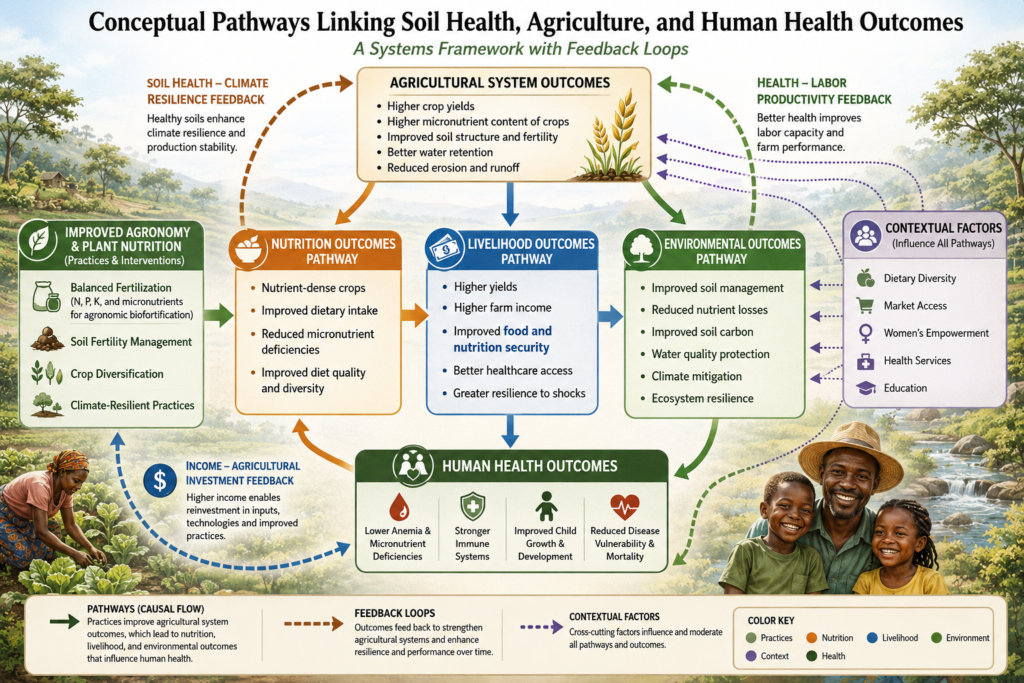
Environmental conditions strongly influence public health outcomes, particularly in rural agricultural regions. Soil management plays a direct role in shaping the environment. Healthy soils with higher organic matter and better structure retain water and nutrient more effectively, reduce runoff, and limit soil erosion. This helps, for example, prevent the transport of sediments, nutrients, and contaminants into rivers and groundwater sources that communities rely on for drinking and household use. When soils are degraded, nutrient losses and sediment runoff increase, contributing to water contamination and raising the risk of diarrheal disease and other waterborne illnesses (WHO, 2023).
Improved crop management using 4R, ISFM, agroforestry, and crop diversification help stabilize landscapes and improve soil structure. These practices reduce land degradation, improve water infiltration and storage, and increase resilience to droughts and floods (FAO and ITPS, 2015). Land degradation and climate stress can intensify food insecurity, while extreme heat and shifting ecological conditions contribute to the spread of vector-borne diseases and heat-related illnesses (IPCC, 2022). By strengthening soil health, improved agronomic practices help reduce these environmental exposure risks and support healthier living conditions for rural communities.
Where the impact is strongest
The link between agronomy and human health outcomes is strongest where:
• Diets depend heavily on locally produced staples
• Soil micronutrient deficiencies are widespread
• Food insecurity is prevalent
• Healthcare services are limited
• Agriculture drives household income
In these contexts, which describe many rural African regions, improved agriculture practice is critical to human health. It is a structural determinant of it. However, better agronomy alone does not automatically translate into better health outcomes. Movements towards dietary diversity, women’s empowerment, access to markets, healthcare systems, and education all mediate the final impact (Ruel et al, 2013).
A shift in perspective
Human health outcomes including mortality rates, disease prevalence, DALYs, quality of life, and functional status are shaped by the interconnected One Health systems. Agriculture and soil health sit at the base of them. Improved agronomy and plant nutrition enhance human health outcomes not by acting as medicine, but by strengthening the environmental, nutritional, and economic foundations upon which health depends. In Africa, where most of the rural population depends on agriculture for both sustenance and income, investing in improved soil fertility and plant nutrition is more than an agricultural priority. It is a long-term public health strategy. Soil health is not just about productivity. It is about resilience and about equity and ultimately, it is about human and planetary well-being.
Ms. Lamsili (e-mail: s.lamsili@apni.net) is APNI Project Communication Manager, Benguérir, Morocco. Dr. Majumdar is APNI Director General, Benguérir, Morocco.
Cite this article
Lamsili, S., Majumdar, K. 2026. Does Improved Agronomy and Plant Nutrition Enhance Human Health Outcomes? Growing Africa 5(1): 46-48. https://doi.org/10.55693/GA51.WJBI7302
REFERENCES
FAO. 2017. The future of food and agriculture – Trends and challenges. https://www.fao.org/3/i6583e/i6583e.pdf
FAO and ITPS. 2015. Status of the World’s Soil Resources (SWSR) – Main Report. https://www.fao.org/3/i5199e/i5199e.pdf
GBD 2019 Risk Factors Collaborators. 2020. Global burden of 87 risk factors in 204 countries and territories, 1990–2019. The Lancet 396:1223-1249.
Hotegni, N.V.F. et al. 2024. Agronomic biofortification of cereals and legumes with iron, zinc, calcium and magnesium for food and nutrition security: Available options for farmers in Sub-Saharan Africa, J. Agric. Food Res. 18, 1-13.
IPCC. 2022. Climate Change 2022: Impacts, Adaptation and Vulnerability. https://www.ipcc.ch/report/ar6/wg2/
Jones, A.D., et al. 2013. Farm production diversity is associated with greater household dietary diversity in Malawi. Food Policy 46:1-12.
Joy, E.J.M., et al. 2015. Zinc-enriched fertilizers as a potential public health intervention in Africa. Plant and Soil 389:1-24.
Pinstrup-Andersen, P. 2013. Nutrition-sensitive food systems: From rhetoric to action. The Lancet 382: 375-376.
Ruel, M.T. et al. 2013. Nutrition-sensitive interventions and programmes. The Lancet 382:536-551.
Webb, P., Kennedy, E. 2014. Impacts of agriculture on nutrition. Food Nutri. Bull. 35(1):126-132.
World Bank. 2023. World Development Indicators. https://databank.worldbank.org/source/world-development-indicators
WHO. 2023. Global Health Estimates. https://www.who.int/data/global-health-estimates