By Shamie Zingore
Phosphorus deficiency is one of the most pervasive constraints to crop productivity and soil health in African farming systems. Its use in agriculture remains extremely low, leading to widespread negative nutrient balances, declining soil fertility, and persistently low yields. An Integrated Phosphorus 4R Management Framework that links source, rate, timing and placement considerations to productivity, profitability, and long term sustainability is proposed for increasing P use and enabling efficient and sustainable phosphorus management.
Continental context: phosphorus deficiency in African soils
Achieving sustainable agricultural intensification in Africa requires addressing chronic soil fertility constraints that limit crop productivity and undermine resilience of farming systems. Among essential macronutrients, phosphorus (P) stands out as a particularly severe and complex constraint. Unlike nitrogen, P cannot be biologically fixed from the atmosphere and must be supplied through fertilizer and rock-P or recycled sources. Average fertilizer P use in Africa remains below 5 kg P/ha, far lower than global averages, and insufficient to offset crop removal. Consequently, cereal yields remain below 30% of attainable levels. Decades of nutrient mining have resulted in widespread soil P depletion across African croplands.
Phosphorus deficiency particularly affects both inherently infertile sandy soils and highly weathered, P fixing soils (Nziguheba et al. 2015). Approximately one quarter of Africa’s land area is dominated by soils with high P adsorption capacity, notably Ferralsols, Acrisols, and Nitisols in the tropical highlands in East Africa (Fig. 1). In these systems, large proportions of total soil P are rendered unavailable to crops due to strong sorption to iron (Fe) and aluminum (Al) oxides. In contrast, large areas of West and Southern Africa are dominated by old, highly weathered sandy soils with intrinsically low P reserves.
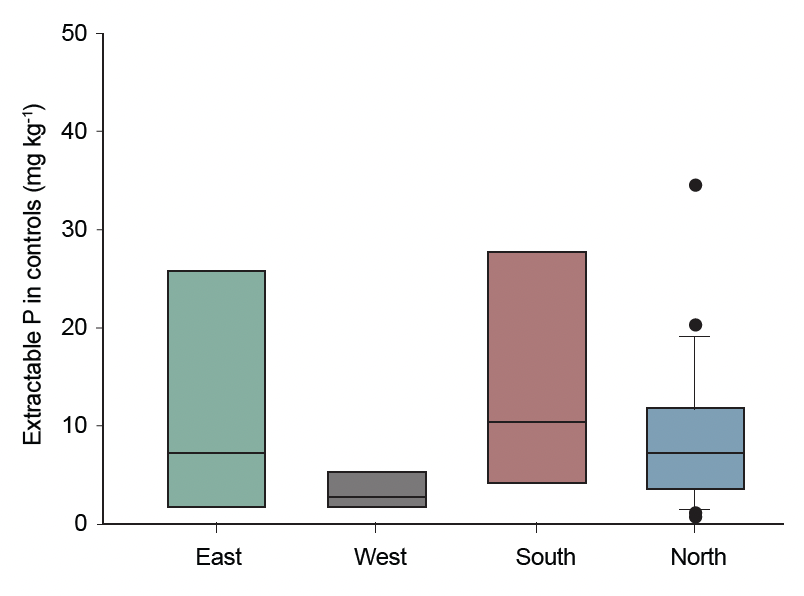
The nature of P deficiency varies regionally:
- East Africa is characterized by high P fixation in acidic soils, despite moderate total P levels.
- West Africa faces severe P scarcity due to low native P stocks in sandy soils, compounded by extremely low fertilizer use.
- Southern Africa exhibits co-limitation by nitrogen and phosphorus, particularly on granitic sandy soils.
- North Africa has signifcant areas under calcareous soils, where high pH and calcium levels precipitate P into unavailable forms.
These contrasting contexts demand differentiated management strategies rather than generalized P management solutions.
Agronomic responses and phosphorus use efficiency
Across Africa, crop responses to P application are consistently observed but highly heterogeneous in space and time. Meta-analyses of multi-location trials indicate that yield responses are strongest in soils with very low extractable P (Kihara and Njoroge, 2013). In such contexts, even small applications (10–20 kg P/ha) can double or triple yields. However, response variability remains high due to interactions with rainfall, soil types, soil organic matter, and management history. Initial yield gains at low P rates are high, but marginal responses decline rapidly beyond 30–40 kg P/ha under most smallholder conditions. This has profound implications for recommendation development: maximizing agronomic efficiency at low rates is not synonymous with restoring soil fertility or closing yield gaps in the medium to long term.
Agronomic PUE, expressed as kg grain increase per kg P applied, provides a useful indicator of P performance. Empirical evidence from sub-Saharan Africa (SSA) shows PUE values ranging from negative to >100 kg grain per kg P, reflecting strong site-specific effects (Kihara and Njoroge, 2013). Highest PUE values are typically observed in severely P-depleted soils, while PUE approaches zero once soil available P exceeds critical thresholds (15 mg/kg Olsen) (Nziguheba et al. 2015). A critical insight from African datasets is that high PUE frequently coincides with low absolute yields. This underscores the need to distinguish between efficiency-driven and productivity-driven P management strategies.
Phosphorus responses are strongly related to nitrogen availability and overall crop management. Numerous studies demonstrate that omission of N can reduce PUE by 30–50%, even in strongly P-deficient soils (Zingore et al. 2023). Conversely, balanced N and P application substantially increases both yield response and economic returns. Other agronomic factors, including plant population density, planting date, weed control, and varietal choice, further modulate P responses, often explaining more variability than fertilizer rate alone.
The 4R Nutrient Stewardship considerations for phosphorus
The 4R Nutrient Stewardship framework provides an operational lens through which complex phosphorus dynamics can be translated into actionable management practices. In African smallholder systems, the value of the 4Rs lies more in guidelines that support structured decision-making adapted to local availability and management constraints.
Right Source: Source selection must account for soil chemistry, crop demand, availability, affordability, and logistics.
Fertilizer: Soluble mineral P fertilizers remain the most effective means of rapidly alleviating P deficiency. However, their high cost, price volatility, and limited accessibility constrain use by smallholder farmers. Fertilizer formulations and blends must therefore be adapted to local soil and cropping contexts to maximize returns.
Rock P: Africa hosts numerous phosphate rock deposits, though their agronomic effectiveness varies widely. Highly reactive sedimentary phosphate rocks, such as those found in parts of West and East Africa, can be effective when applied under suitable soil conditions, particularly acidic soils. Partial acidulation, compaction with soluble fertilizers, and co-application with organics can substantially enhance their effectiveness.
Organic resources: Organic inputs such as manure, compost, and crop residues generally contain low P concentrations and are available in limited quantities. While insufficient to replenish soil P stocks at large scale, they play a critical role in enhancing P availability through biological and chemical mechanisms, improving soil structure, and supporting long-term fertility.
Right Rate: Determining the right rate requires balancing short-term profitability with long-term soil fertility objectives. Evidence from long-term trials indicates that rates sufficient to generate high yield response and maximize rate of returns (10–20 kg P/ha) are often inadequate to prevent soil P depletion (Nziguheba et al., 2002). Rates above 20 kg P/ha are required to avoid depletion in many systems. This creates a delicate trade-off between short-term yield and economic objectives and long-term sustainability.
Right Time: Timing of P application influences both efficiency and residual value. Seasonal applications at planting are generally most effective for soluble sources and highly reactive PRs. In high P-fixing soils, repeated low-dose applications outperform one-off high rates due to reduced fixation losses. Multi-season strategies that combine initial soil P build-up with maintenance applications are rarely implemented but represent a critical frontier for sustainable management.
Right Place: Placement is among the most powerful levers for improving P efficiency under low-input conditions. Banding or spot placement concentrates P in the root zone, reduces soil–fertilizer contact, and enhances early crop uptake. Empirical data from East and Southern Africa indicate yield gains of 15–30% from improved placement alone at low P rates, making this practice especially relevant for resource-constrained farmers.
Short-term response based recommendations often fail to capture the cumulative effects of P depletion and replenishment. Strategic P management recognizes the dual objective of meeting immediate crop demand while gradually rebuilding soil P capital. Regular soil P monitoring is essential, as soil P depletion occurs more rapidly and is less resilient than nitrogen or potassium. Failure to apply P even for a few seasons can rapidly induce severe deficiency, even in soils with historically high P status.
Leveraging cropping systems and legumes
Legumes exhibit a disproportionately strong response to phosphorus due to the central role of P in nodulation and biological nitrogen fixation (Nziguheba et al. 2015). Across SSA, P application to grain legumes commonly results in more than doubling yields, alongside improvements in grain quality and nutritional value. The proportion of responses often exceed those observed in cereals at comparable rates. Beyond direct yield effects, P application to legumes generates substantial residual benefits for subsequent cereal crops. Residual P, combined with enhanced soil nitrogen supply, can significantly increases cereal yields without additional fertilizer input. This amplifying effect positions legumes as strategic entry points for P investment in cereal-based systems.
The slow progress in increasing P use in Africa reflects not only biophysical constraints but also structural socio-economic and policy barriers. High fertilizer prices, weak input distribution systems, limited access to credit, and inadequate advisory services constrain farmer adoption. Gender disparities further influence access to inputs and information.
Policy reforms that support fertilizer affordability, local blending, soil testing services, and integrated advisory platforms are critical for scaling efficient P management practices.
Toward an Integrated Phosphorus 4R Management Framework
The Integrated Phosphorus 4R Management Framework provides a unifying conceptual structure that links soil processes, crop demand, farmer decision-making, and enabling environments into a coherent system for sustainable phosphorus management in Africa (Fig. 2).
The framework is anchored in soil P capital, defined by total soil P stocks and their partitioning between labile and stable pools. African soils are characterized by either low total P reserves or strong P fixation, resulting in limited plant-available P despite large total stocks in some cases. Key soil constraints, including P fixation in acidic and highly weathered soils, Ca–P precipitation in calcareous soils, and low buffering capacity in sandy soils, that govern P availability must be considered in designing P investment and management solutions.
At the core of the framework sits the 4R decision space—Right Source, Right Rate, Right Time, and Right Place—depicted as an adaptive management interface rather than a static prescription. Each R interacts dynamically with soil constraints and crop demand:
Right Source decisions are conditioned by soil chemistry (acidic vs calcareous), availability of applied and recycled P from fertilizer, phosphate rock, and organic inputs, as well as labor and mechanization constraints.
Right Rate balances profitability, risk, and sustainability, explicitly distinguishing between response-driven rates and recapitalization rates required to rebuild soil P stocks. Regular soil P assessment is essential to monitor changes and timely adjustment of rates. Rates must be adjusted to crop-specific and system-level P demand. Strategic inclusion of grain legumes, rotations, and residue management pathways enhances both direct P uptake and residual benefits.
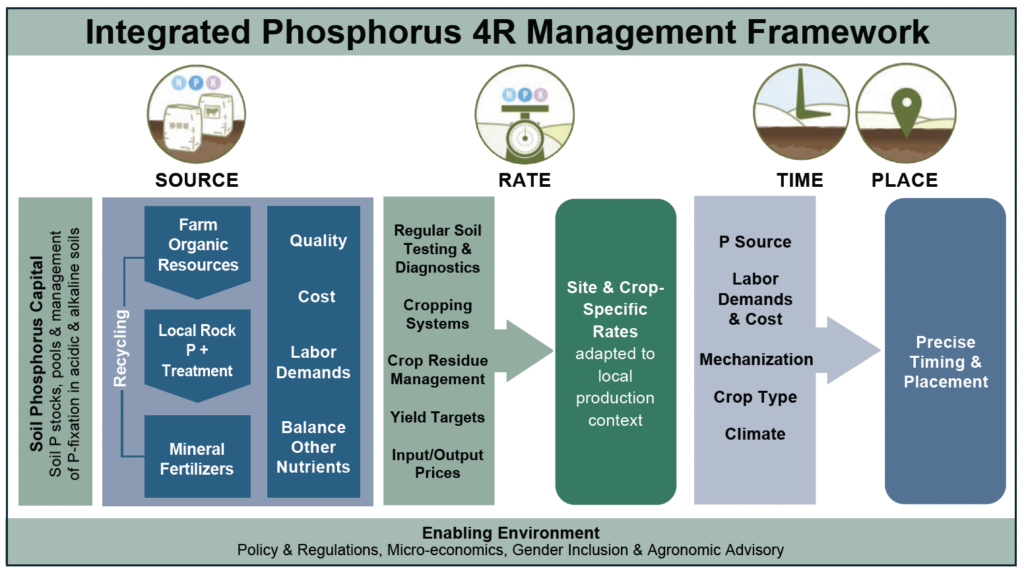
Right Time reflects both intra-seasonal timing (e.g., placement at planting) and inter-seasonal strategies that account for residual P effects and fixation dynamics.
Right Place captures the strong influence of placement on P use efficiency under low-input conditions, particularly through banding and spot application. Both time and place are influenced by P sources and rates, as well as labour demands and cost, type of implements or machinery uses, crop type and climatic conditions.
Surrounding the biophysical and management core is the enabling environment, which shapes feasibility and adoption. This includes fertilizer and input markets, pricing and subsidy policies, access to credit, soil testing and diagnostic services, extension and digital advisory platforms, and gender-differentiated access to resources. The framework explicitly situates farmer decision-making within this broader context, acknowledging that optimal 4R solutions are constrained by affordability, risk perception, input and output markets and institutional support.
Conclusions and research priorities
Phosphorus deficiency remains a central constraint to achieving food security and sustainable intensification in Africa. Addressing this challenge requires a shift from blanket recommendations to locally adapted, strategic, and system oriented P management. Integrating 4R principles to optimize short-term agronomic and economic goals with long.term soil P capitalization, cropping system design, and enabling policies is essential for effectively addressing the soil P Challenge in Africa.
Dr. Zingore (s.zingore@apni.net) is Director of Research & Development, APNI, Benguérir, Morocco.
Cite this article
Zingore, S. 2025. Innovating Locally Adapted Solutions for Sustainable Phosphorus Use in Africa. Growing Africa 4(2):14-17. https://doi.org/10.55693/ga42.BLYY7302
REFERENCES
Kihara, J., Njoroge, S. 2013. Phosphorus agronomic efficiency in maize-based cropping systems: a focus on western Kenya. Field Crops Res. 150, 1–8.
Nziguheba, G., et al. 2015. Phosphorus in smallholder farming systems of sub-Saharan Africa: implications for agricultural intensification. Nut. Cyc. Agroecosys. 104, 321–340.
Nziguheba, G., et al. 2002. Soil phosphorus dynamics and maize response to different rates of phosphorus fertilizer applied to an Acrisol in western Kenya. Plant & Soil 243, 1–10.
Zingore, S., et al. 2022. Novel insights into factors associated with yield response and nutrient use efficiency of maize and rice in sub-Saharan Africa. A review. Agron. Sustain. Dev. 42, 82.