By Kaushik Majumdar
Phosphorus deficiency severely limits crop productivity in Africa, threatening food security and sustainability. Current application rates are far below global needs, requiring a five-fold increase. Solutions include improving fertilizer access, reducing supply chain costs, and adopting 4R Nutrient Stewardship for efficient, context-specific phosphorus use to restore soil health and resilience.
The 8th Sustainable Phosphorus Summit (SPS8) was held in Africa for the first time this year—an important milestone that coincides with growing consensus that Africa must substantially increase fertilizer use to meet food security goals. Decades of continuous cropping, minimal fertilizer inputs, and low recycling of organic matter have resulted in widespread soil nutrient depletion across the continent. Among these constraints, phosphorus (P) deficiency stands out as one of the most yield-limiting factors, severely compromising soil productive capacity (Tauro et al., 2024).
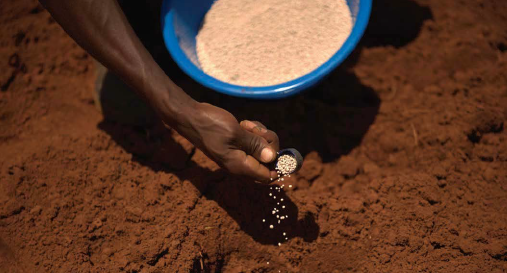
The consequences of chronic P deficiency are far-reaching. Low crop productivity, soil degradation, persistent hunger, and loss of livelihoods are direct outcomes. Declining soil fertility has also encouraged expansion into extensive agriculture, driving deforestation, greenhouse gas emissions, and biodiversity loss. Addressing P deficiency is therefore not only an agronomic imperative, but also a social, economic, and environmental necessity.
The scale of the phosphorus challenge
Analyses suggest that a five-fold increase in P application will be required to sustain food security in Africa (Sattari et al., 2012). Relative to 2016 levels, the elemental P required to feed Africa’s projected 2050 population is estimated at between 1.7 and 3.4 million t annually (Magnone et al., 2022). These figures highlight the magnitude of the challenge and the urgency for action.
Compelling evidence shows that balanced, context-specific P use can substantially raise crop yields across diverse African agro-ecologies. Meta-analyses of nutrient omission trials (Njoroge et al., 2019; Zingore et al., 2022) demonstrate significant cereal yield responses to P across all soil fertility classes, often exceeding 1 t/ha. Balanced P application not only increases yields, but also improves yield stability and nutrient use efficiency, reinforcing its central role in sustainable intensification.
Yet, despite its importance, P use in Africa remains extremely low. Application rates are generally below 10 kg P/ha/yr. While average inorganic fertilizer use is approximately 23 kg/ha, farmers in sub-Saharan Africa typically apply only about 7 kg P/ha, with many regions using even less. This stark gap between need and practice underscores a systemic failure rather than a lack of agronomic potential.
Policy momentum and persistent systemic barriers
Increasing fertilizer use is essential to achieve food security, reduce poverty, and halt land degradation. At the 2024 Africa Fertilizer and Soil Health (AFSH) Summit in Nairobi, African Heads of State reaffirmed their commitment—under the African Union—to improve access to affordable fertilizers and boost crop productivity. The endorsed 10-year Action Plan aims to triple fertilizer use and double food production across the continent.
While such ambitions are critical, achieving them requires a coordinated roadmap that tackles the structural constraints that have historically suppressed fertilizer use. Access, defined by both availability and affordability, remains the dominant bottleneck. Evidence shows that transaction and transportation costs over relatively short distances (approximately 35 km) can raise fertilizer prices by 50% and reduce use by up to 75% (Minten et al., 2013). In some cases, farmers located just 10 km from a distribution center face costs comparable to transporting fertilizer over 1,000 km from international ports.
These last-mile supply chain constraints account for a disproportionate share of fertilizer prices in African countries. Farm-gate prices can reach up to four times those in Europe (Njoroge et al., 2023), severely undermining affordability and adoption. Reducing these inefficiencies is therefore central to any strategy aimed at increasing P use.
From access to effective use: the knowledge imperative
Improving physical access to fertilizers must be complemented by empowering farmers with knowledge to use them efficiently and profitably. African smallholders operate across an overwhelming diversity of climate–soil–crop combinations, demanding context-specific agronomic solutions. Limited access to actionable, locally relevant information increases production risks and lowers returns on fertilizer investments, particularly for P, which is prone to fixation in the continent’s predominantly acidic soils.
Conclusion
The urgency of sustainably increasing P use in Africa was strongly endorsed at SPS8 as a prerequisite for future food and nutrition security, as well as environmental sustainability. Removing supply and value-chain constraints, improving the availability and affordability of P fertilizers, and scaling scientifically credible, contextually relevant agronomic practices are all essential pillars of sustainable P management. Together, these actions can unlock Africa’s soil productivity, accelerate sustainable intensification, and support resilient food systems for generations to come.
Dr. Majumdar (k.majumdar@apni.net) is Director General, African Plant Nutrition Institute (APNI), Benguérir, Morocco.
Cite this article
Majumdar, K. 2025. Unlocking Africa’s Food Systems: Why Phosphorus Management Is Central to Sustainable Intensification. Growing Africa 4(2):2-4. https://doi.org/10.55693/ga42.HWLR5740
REFERENCES
Magnone, D., et al. 2022. The impact of phosphorus on projected Sub-Saharan Africa food security futures. Nature Comm., 13, 6471.
Minten, B., et al. 2013. The last mile(s) in modern input distribution: Pricing, profitability and adoption. Agric. Econ., 44(6).
Njoroge, S., et al. 2019. Learning from the soil’s memory: Tailoring fertilizer application based on past manure applications increases fertilizer use efficiency and crop productivity on Kenyan smallholder farms. Eur. J. Agron., 105, 52–61.
Njoroge, S., et al. 2023. The impact of the global fertilizer crisis in Africa. Growing Africa 2(1), 3–8.
Sattari, S., et al. 2012. Residual soil phosphorus as the missing piece in the global phosphorus crisis puzzle. Proc. Nat. Acad. Sci., 109, 6348–6353.
Tauro, T.P., et al. 2024. The value of manure and phosphorus application to unlock immobilized microbial phosphorus for sustainable intensification of maize in Zimbabwe. Growing Africa 3(1), 28–31.
Zingore, S., et al. 2022. Novel insights into factors associated with yield response and nutrient use efficiency of maize and rice in sub-Saharan Africa: A review. Agron. Sus. Dev., 42, 82.