By Kwame Agyei Frimpong, Ransford Opoku Darko, Selorm Akaba, Isaac Boateng, and Agnes Naa Abeley Abbey
Soil underpins Africa’s food security, yet declining fertility continues to limit smallholder productivity and livelihoods. In Ghana, this challenge is closely tied to socio-economic factors that influence farmers’ ability to adopt improved practices. This study shows the need for a dual approach: locally tailored promotion to suit situations where district-level differences are impacting relative adoption rates for ISFM, and unified, broad-based support programs for 4R Nutrient Stewardship which shows evidence of more consistent uptake by farmers. Together, these strategies can improve yields, strengthen soil health, and build climate resilience.
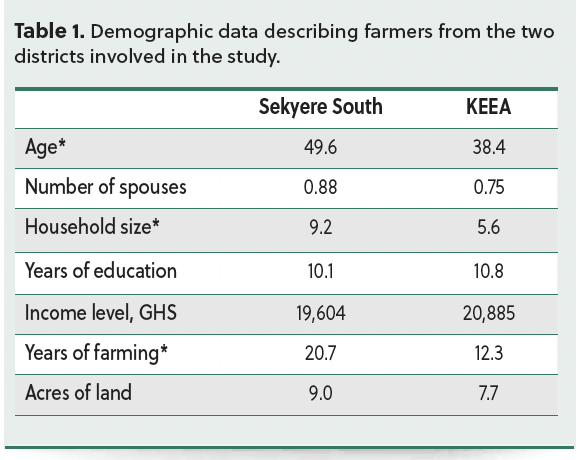
This research focused on two contrasting districts in Ghana: Sekyere South, located in the semi-deciduous forest zone, and Komenda-Edina-Eguafo-Abirem (KEEA), located in the coastal savannah. These regions differ not only in climate and crops but also in the socio-economic profiles of their farmers. Sekyere South is home to older, more experienced farmers who often practice mixed cropping, while KEEA’s farmers are younger, more open to innovation, and more likely to specialize in monocropping.
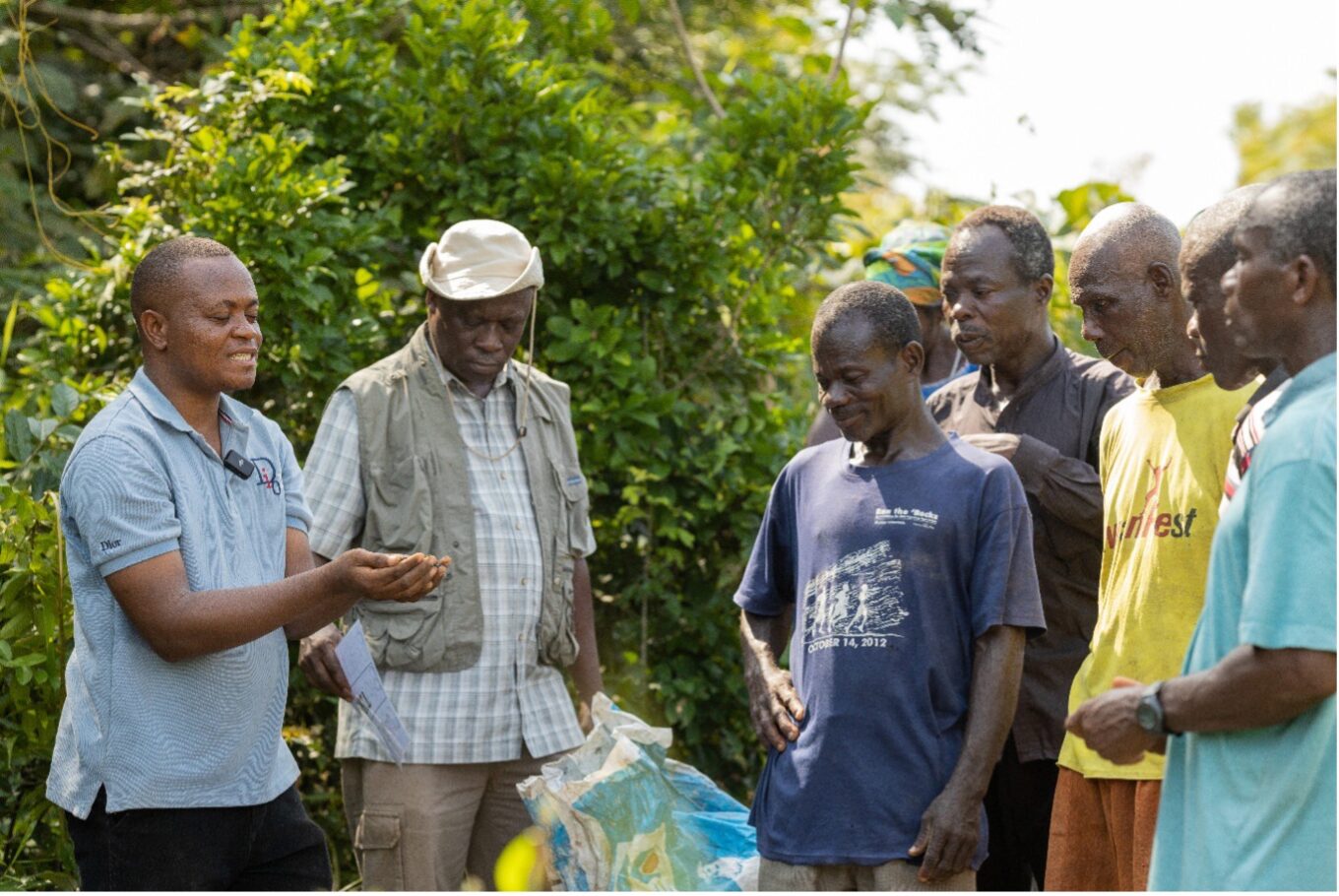
The study engaged 100 smallholder farmers (50 from each district) in a series of workshops, surveys, and focus group discussions. The aim was to assess their awareness of two key soil fertility strategies: Integrated Soil Fertility Management (ISFM) and 4R Nutrient Stewardship (4RNS), and to explore how factors like education, land tenure, and access to resources influence their adoption of these practices.
The knowledge gap
One of the most striking findings was the information deficit. While 57.9% of farmers had heard of ISFM, only 43.2% were familiar with 4RNS (Table 2). This gap matters: without knowledge of best practices, farmers are less likely to adopt them, regardless of their potential benefits.
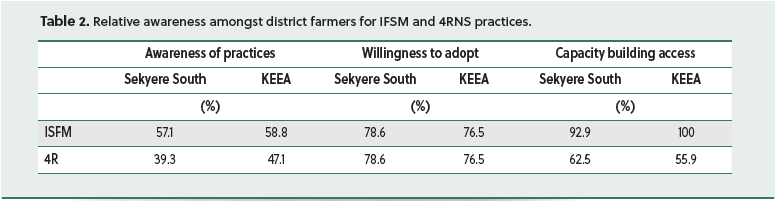
Despite this, over three-quarters of the farmers expressed willingness to implement both ISFM and 4RNS, provided they receive adequate training and financial support. A female farmer from KEEA summed up the sentiment: “I regret that we have not had this kind of information in the past. I think that if we had known about proper soil fertility management, our livelihoods would have improved greatly by now.”
Socio-economic barriers
Education
Education emerged as a powerful enabler. Farmers with higher levels of education were more likely to adopt recommended practices, use agricultural information, and participate in capacity-building programs. In KEEA, a higher percentage of farmers had completed senior high school or university compared to Sekyere South, where more farmers had only primary or junior high education. This difference translated into greater openness to innovation and new technologies.
Land Tenure
Land security is another critical factor. Farmers who own their land or use family land are more motivated to invest in long-term soil fertility improvements. In contrast, those who rent or sharecrop are less likely to adopt practices that require upfront investment, fearing they may not reap the long-term benefits. In Sekyere South, 39.3% of farmers used family land and 33.9% owned their land, while in KEEA, cash rental was more common (35.3%).
Financial Resources
Unsurprisingly, money matters. Nearly half of KEEA farmers and over a third in Sekyere South cited inadequate finance as a major constraint. Access to credit, subsidies, and affordable inputs is essential, especially for young and female farmers who often face additional barriers. Most farmers rely on personal savings to finance their operations, with only a minority accessing loans.
Technical Support
Extension services are the lifeline for many smallholders. While 94% of farmers received some support from government extension agents, only a third accessed private sector advice. Notably, 5% of Sekyere South farmers reported receiving no technical assistance at all, highlighting gaps that need to be filled.
Demographics and Diversity
The study revealed significant demographic differences between the two districts. Sekyere South’s farmers are older (average age 49.6 years) and have more years of farming experience (20.7 years) compared to KEEA (average age 38.4 years, 12.3 years of experience). Larger household sizes in Sekyere South suggest more available labor but also greater financial demands.
Gender dynamics are also shifting. While men still make up a slight majority, female land ownership is notable—18% in Sekyere South compared to 11% for men—challenging traditional norms and highlighting the importance of supporting women farmers.
Farming Systems
Farming practices reflect both tradition and adaptation. In Sekyere South, mixed cropping dominates (69.1%), providing resilience against pests, diseases, and market shocks. KEEA, by contrast, leans toward monocropping (47.1%), often driven by market demand and resource specialization. Organic amendments are more common in Sekyere South, where 61.5% of farmers use them, compared to 46.7% in KEEA. Animal manure is the most popular organic input, followed by compost. These practices are linked to improved soil fertility and long-term sustainability.
Adoption in Practice
Despite the challenges, 77.6% of farmers expressed willingness to adopt ISFM and 4RNS if given the right support. Willingness to adopt both practices was similar across districts—Sekyere South (78.6%) and KEEA (76.5%), which suggests that when barriers are addressed farmers are eager to innovate. However, the study found that adoption is not just about willingness; it’s about capacity. Farmers need relevant training, financial support, and secure land tenure to make lasting changes.
The Role of Extension and Capacity Building
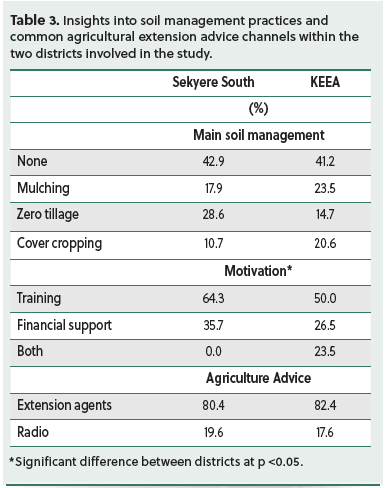
Training and extension services are vital. In both districts, most farmers rely on extension agents for advice, with radio as a secondary source (Table 3). Capacity-building programs are more widespread in KEEA, where 100% of farmers participated in at least one training, compared to 92.9% in Sekyere South (data not shown). Sekyere South farmers are more likely to be motivated by training alone, while KEEA farmers are more in need of a combination of training and financial support. One-size-fits-all approaches should be avoided, and interventions must be tailored to local realities.
Both ISFM and 4RNS aim to enhance soil health, increase crop productivity, and promote environmental sustainability. When implemented together, these approaches can generate synergistic benefits, such as improved soil structure, greater nutrient availability, and reduced environmental degradation.
However, the two approaches differ in how they are most effectively promoted and adopted. ISFM extension tends to require district-specific strategies that account for local agroecological conditions and socio-economic factors influencing the effectiveness of integrated soil, nutrient, and water management practices. In contrast, the study indicates that 4RNS has achieved steady acceptance, suggesting that a more standardized, broad based extension approach can successfully promote its adoption without extensive localization.
To effectively support sustainable agricultural development, it is essential for extension services, public–private partnerships, and local government initiatives to work collaboratively in encouraging the adoption of both ISFM and 4R practices. Providing targeted subsidies or incentives for relevant inputs could further accelerate adoption, particularly among resource constrained farmers.
This integrated approach has the potential to serve as a model for other regions in Ghana and similar agroecological zones. By addressing the need for localized ISFM strategies while maintaining consistent support for 4R practices, agricultural programs can improve sustainability, enhance resilience to climate change, and strengthen food security. Ultimately, this combined strategy is critical for advancing sustainable agricultural systems, especially in regions that are highly vulnerable to climate risks.
Policy implications and recommendations
The findings point to several actionable recommendations:
Tailored Interventions: Support programs should be customized to farmers’ socio-economic profiles, addressing specific needs related to age, education, income, and land tenure.
Land Tenure Reforms: Secure land rights encourage long-term investment in soil fertility.
Strengthen Extension Services: Expand both public and private advisory services, with a focus on reaching women and youth.
Financial Innovations: Improve access to credit, microfinance, and input subsidies, especially for at-risk groups.
Capacity Building: Scale up training programs, using both traditional and digital platforms to reach diverse audiences.
Towards sustainable soil and livelihoods
The future of African agriculture is highly linked to the success of smallholder farm householders. By understanding and addressing the socio-economic realities of farmers at the farm level, we can unlock the potential for sustainable soil management, higher yields, and improved livelihoods. Lessons from Ghana’s Sekyere South and KEEA districts indicate that Africa’s farmers, given the right considerations, are ready to grow, innovate, and feed the continent.
Acknowledgement
Information in this article is based upon the author’s work Assessing the influence of farmers’ socio-economic orientation on the adoption of recommended soil fertility management practices. Published within Int. J. Agril. Res. Innov. Tech. 15(2):107-126. https://doi.org/10.3329/ijarit.v15i2.87914
Prof. Kwame Agyei Frimpong (e-mail: kfrimpong@ucc.edu.gh) is Professor, Department of Soil Science, School of Agriculture, University of Cape Coast (UCC), Ghana. Prof. Ransford O. Darko is with the Department of Agricultural Engineering, School of Agriculture, UCC. Dr. Selorm Akaba is with Department of Agricultural Economics and Extension, School of Agriculture, UCC. Dr. Isaac Boateng is with the Department of Science and Agriculture, St Louis College of Education, Kumasi, Ghana. Dr. Agnes Naa Abeley Abbey is with the Department of Soil Science, School of Agriculture, UCC and Department of Renewable Energy Technology, School of Engineering, Cape Coast Technical University, Ghana.
Cite this article
Frimpong, K.A., Darko, R.O., Akaba, S., Boateng, I., Abeley Abbey, A.N. 2026. How Socio-Economic Factors Shape Soil Fertility Management in Ghana’s Smallholder Farms. Growing Africa 5(1):34-37. https://doi.org/10.55693/GA51.EYFW6809